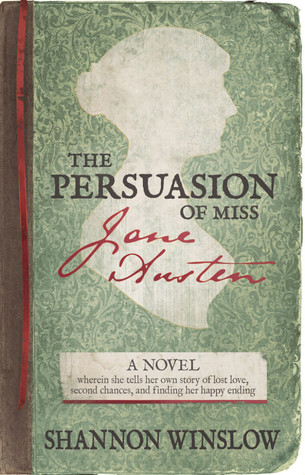
 That was different! A what-if? scenario that lots of Jane Austen fans must have wondered about — what if Dear Jane had not been a spinster all her life before dying at the tragically young age of forty-one? What if she had in fact enjoyed the same happy ending that she so generously gave all her heroines? It sounds implausible, but astonishingly, it really works.
The thesis is that Persuasion, perhaps Jane’s most romantic novel with its regrets and a miraculous second chance for happiness, mirrors Jane’s own life. While celebrating the marriage of her brother Henry to Eliza, Jane meets Captain Devereaux, a Frenchman who has escaped the troubles in France to join the British navy against the French. There is a whirlwind romance, quickly followed by a proposal and acceptance. But Captain Devereaux has not yet made his fortune, and Jane is persuaded to give him up. They part in anger, thus far mirroring the events of Persuasion closely, highlighted by a number of quotes.
Later, they meet again, but (again, in a reflection of Persuasion), there is no happy reunion. Instead, Captain Devereaux becomes entangled with another young woman, and becomes engaged to her, even while recognising the reigniting of his feelings for Jane. So far, so identical. But after this, Jane produces a happy ending for Anne Elliott and Captain Wentworth, while her own life (according to this book) takes a different direction. Captain Devereaux is swept up into the renewal of hostilities with France and vanishes from view, leaving Jane bereft.
I’m not going to spoil the surprise by detailing how things go from then onwards. It seemed perhaps a touch implausible, but then to fit the known facts of Jane’s life as far as possible (which the author has clearly gone to great pains to do) things had to be somewhat convoluted. As I said above, it works for me, but then (like most romance readers) I love a happy ending.
What I think is most astonishing is how well the writing mirrors Jane’s own language. Few modern authors can reach this level of authenticity, and if it largely lacks Jane’s biting wit, well, who could possibly match it? I will never criticise an author on that account. Jane was a towering talent, and no one truly comes close, but this is as close as anyone gets.
In fact, the author writes ‘British’ so well that the odd Americanism is all the more jarring for being so rare. I noticed ‘on High Street’ (for some reason, Brits say ‘on the High Street’), and Jane’s sister-in-law, the former Mary Lloyd, is called Mary Lloyd Austen, in the American fashion of incorporating the maiden name. There were some minor typos, too (demure for demur, discrete for discreet), but nothing drastic.
I’ve had this on my Kindle for a long time (three years!) and now I’m wondering just why I waited so long to read it. A very enjoyable read, beautifully written without taking liberties with history and a cracking romance as well. Five stars and highly recommended.
 A strange little book, which picks up a couple of years after Pride and Prejudice finished, and ties up all the loose ends with elaborately double-tied bows. It’s beautifully written, badly punctuated and varies in tone from sublime to merely dull, but it has two incomparable assets: the humour is glorious and it makes a hero of Mr Bennet. These may not be unconnnected.
 This is only the second P&P variation I’ve ever read [*], and possibly the most expensive ebook I’ve ever bought, but it’s hard to imagine there will ever be anything to top it. The author took two characters we feel we already know well and peeled back layer after layer to reveal every last fascinating nuance of their characters. It’s a virtuoso performance. Perfection.
 Well, that was fun! I’ve been hoping to read this book for ages, since it’s touted as the definitive version of Sanditon, Jane Austen’s unfinished work, but I was waiting patiently for it to come out in ebook form. But a clear-out of the loft produced a box full of old Georgette Heyer paperbacks, and amongst them this Signet book from 1975, the pages yellowed and brittle with age. I haven’t read a dead tree book in years, but this was one I couldn’t resist.
 This book enchanted me from start to finish. I don’t normally read Jane Austen fan fiction (JAFF), but if it were all up to this standard, I’d never read anything else. The book is an imagining of Pride and Prejudice which veers off even before the Netherfield ball. Elizabeth indulges in one country walk too many, and has to be rescued by Mr Darcy. When rumours start to fly that compromise her reputation, Mr Bennet calls upon Mr Darcy to do the honourable thing – and he does. Now, there must be a million JAFF books that start off with Elizabeth forced into marriage with Darcy by one contrivance or another, but the author makes this feel completely believable.