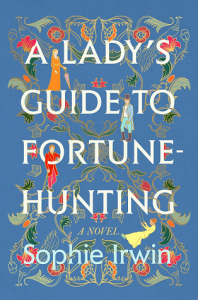
This is one of those books that must have had the agent chuckling reading the synopsis. It sounds such a delightfully amusing romp, but it’s the execution that falls a bit flat initially. Fortunately, it acquires some depth just in the nick of time.
Here’s the premise: Kitty Talbot is the eldest of five sisters left in dire straits by the death of her parents. Fortunately, she’s betrothed to a neighbour, so he’ll take care of them, won’t he? But the opening scene of the book (which is perhaps its zenith) shows the neighbour rather grumpily jilting Kitty. Now what’s she to do? If she doesn’t find a way to rescue their finances in three months flat, they’ll all be out on their ear, and then what will they all do? But Kitty is a resourceful woman; she’ll go up to London and find herself another husband rich enough to keep the sisters and their home afloat. There’s an ‘aunt’ (a friend of their mother’s) who will help to introduce them into society, younger sister Cecily can go too, for the experience, and how hard can it be, really? But at the very first outing, a trip to the theatre, where they are introduced to some likely suitors with reasonable incomes, Kitty sees the fabulously wealthy de Lacy family and a chance meeting with them soon afterwards releases all her ambition. Never mind the reasonable incomes, she wants a rich husband, and Archie de Lacy will do very well.
At first things go swimmingly. Archie, who’s young enough and innocent enough not to realise he’s being manipulated, is soon head over heels in love with Kitty, his suspicious mother is brought round Kitty’s thumb too, and all is looking rosy, when Archie’s older brother, Lord Radcliffe, arrives from darkest Devonshire to put a spoke in Kitty’s wheel. Somehow, she manages to wheedle her way around him, too – not to allow her to marry Archie, but Radcliffe will help ease her into their higher level of society and find the rich, complaisant husband she needs.
At this point, neither of the principals is very appealing. Kitty is single-mindedly pursuing a rich husband, the very worst kind of fortune hunter, and Lord Radcliffe (James to his family) is only reluctantly drawn from his Devonshire home, having successfully avoided London society and, to a large extent, his own family ever since he returned from the continent after Waterloo. So yes, this is a very much a soldier dealing with PTSD, but it’s handled very lightly, and in a proper Regency way, so that’s fine. And there are Daddy issues, too, but again, it’s not laid on with a trowel. But still, he’s very detached from his own family, and I really don’t like him very much at this point.
It’s worth mentioning here that the version of the Regency the author creates is not one I recognise. It’s true that every author creates his or her own vision of the Regency. Georgette Heyer may have been the first, but her ideas are not cast in stone, and there’s plenty of scope for alternative visions. However, when you are talking about the upper levels of society, the class system is baked into everything. Amelia and Archie de Lacy, for instance, would not have been walking in the park every day; they would have ridden or driven in a barouche or something equally stylish, to distinguish themselves from the riff-raff with less money. Nor would Kitty, Cecily and their ‘aunt’ ever have been admitted into any of the fashionable balls; admission was only to those known to the hostess, and, to be honest, all those in society recognised instantly those who were not of their class. Clothes, jewels, accent, manners all kept the penniless masses at bay. Kitty’s remarkable success in inveigling her way into all the fashionable squeezes (and even Almack’s!) makes a good story, but I didn’t find it remotely plausible.
So up to the halfway point, I was not really enjoying this at all. But then something interesting happens. The two protagonists, Kitty and James, despite being sworn enemies, start to open up to each other in interesting ways, and become much more real and yes, even sympathetic. Finally, some real depth to the characters. The ending is rather elegant with not one but two dramas to be resolved, and a fine, romantic ending for our hero and heroine.
The writing is strong, although infested with anachronisms (stablehands, for instance, instead of ostlers or grooms). There are one or two odd word choices. For instance, ‘outfitted yourself well’ which should be acquitted. My biggest complaint, though, is the use of titles that actually exist. There’s a Duke of Leicester, for instance, even though there’s a real Earl of Leicester. Lord Montagu and the Cavendish family are also real entities that existed in the Regency and are still in existence today. To my mind, it’s very rude to use the names of real, identifiable people as fictional characters. But that apart, this is an interesting and unusual story. It’s not quite as whimsical or amusing as it might think it is, however, but the more intense notes later in the book manage to lift it above the ordinary. I was torn between three and four stars, but since this is a debut, I’ll be generous and give it four stars.

 These books are a constant delight, and thank goodness Mary Lancaster is such a prolific author that hopeful readers never have to wait too long for the next instalment of that ill-assorted pair, Piers and April.
 There’s never any knowing what will drop from the creative pen of this author, but I know for sure it will always be interesting, and beautifully written. After a run of slightly oddball and frankly curious books, this is a stellar return to the form of the very first of this series.
 Another winner from Joan Smith, with a charming heroine, an initially grumpy but soon melting hero, some amusingly horse-mad minor characters and a creative ending.
 Another good outing for our likeable but improbable sleuths, Piers and April. Not a lot of progress on their relationship, but I suspect the author’s going to milk it for all its worth. I have to say, I don’t quite see where the inevitable happy ending is coming from, but we’ll see.
 This is an odd sort of book, one where I hated the heroine for most of it, found the hero incomprehensible and thought many of the events implausible, yet I still enjoyed it thoroughly. Partly, that’s because of its age; it doesn’t conform to modern standards and so I found it surprising in a multitude of ways, and that’s far better than being predictable. There are some spoilers below, so don’t read on if you don’t want to know.
 The third part of this series of short cosy/Regency mysteries, which are best read in sequence. This episode worked even better than the previous two – not sure whether the author’s getting into her stride now, or whether the characters have just reached a more interesting stage of their relationship, but I have to say I enjoyed this a lot.
 This is book 2 in the series, and although this could be read as a stand-alone, it will certainly be more meaningful if you read the first book beforehand. This is another short read, an intriguing murder to solve, some interesting locals in the frame, a mini-romance on the side and (the star attraction) the developing and most unusual relationship between the hero and heroine.
 NOTE: not a Regency romance as such, more of a Regency cosy mystery.
 Oh dear. Two fairly hard-to-like principals, a very uneven plot, some over-the-top silliness from the heroine, and a rabbit-from-the-hat romance (you know how this one goes: I don’t like you… I don’t like you… oh, I’m in love). I kept reading because… well, I’ll get to that, but boy, was it a slog, sometimes.