
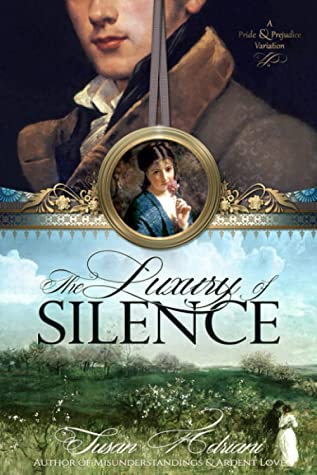
 I haven’t read many Pride and Prejudice variations, but they were uniformly awesome. This didn’t quite match those stellar heights, but the bar was set quite high and this is a pleasant enough read, although it doesn’t add any great insights into the characters.
Here’s the premise: the story starts, intriguingly enough, at Ramsgate, with Darcy and Georgiana recovering from Wickham’s elopement attempt. Here the author has chosen to have Wickham draw Georgiana further from the path of virtue, for when Darcy discovers them, there’s bare flesh on display, and uncertainty about just how far matters have gone. Georgiana has retreated into her shell, unwilling to face the world. Darcy is riven with guilt and self-reproach – he should have protected his sister better! Some time in London does nothing to improve the mood of either of them, but perhaps quiet country life would offer a healing environment? Darcy accepts Bingley’s invitation to join him at Netherfield.
And here we are at the opening of the book, although with the addition of Georgiana to the Netherfield party. Everything else is the same. But almost immediately, the plot veers away from the canonical route; on his first day, Darcy goes for an early morning ride to a nearby viewpoint and immediately bumps into a young lady out for a walk – a surprisingly impertinent and undeferential young lady. After a few hostile exchanges of fire, Darcy discovers that said young lady has a streak of mischief in her – not to mention a pair of fine eyes. They part as friends, but even so, when he encounters her again at the Meryton assembly a few days later, he still manages to insult her. But once more, the plot shoots off at a tangent, for Bingley insists on Darcy apologising and offering to dance with Elizabeth, whereupon she refuses him.
Jane’s visit to Netherfield on horseback and subsequent illness is as per the original, with the happy result of throwing Darcy and Elizabeth together for more of those early morning outings, long discussions in the drawing room after dinner and bonding over Darcy’s dog, Solomon. And so it goes on, with the original story burbling away almost unnoticed in the background, because the main focus here is the growing closeness between Darcy and Elizabeth. He is able to talk openly to her as to no one else in his constrained life, largely because she’s neither a disapproving relation nor an ambitious fortune hunter. He likes her lively wit (as do we all!), and although he doesn’t acknowledge it to himself for a long time, he’s gradually sliding into love with her. For her part, Elizabeth enjoys the intellectual challenge (she’s made out to be something of a bluestocking here), and sees him as nothing more than a friend. He’s absolutely out of her league, after all.
Now this is all very lovely, but it never feels very true to the original characters. We see nothing of Darcy’s struggle to suppress his feelings for Elizabeth, his revulsion at the prospect of such a low marriage or, to be honest, his pride. Nor is her prejudice much in evidence. Instead, there are very few bumps in the road to the inevitable proposal. The minor characters, too, are air-brushed into charming and good-hearted eccentricity, rather than silliness or (in Lydia’s case) outright immorality. Darcy says airily that the younger Bennet girls just need a little bit of guidance to bring them back to sensible behaviour. Because Darcy has no problem proposing to Elizabeth, there is no objection to Bingley marrying Jane, either. Wickham creates the only tension, but even he is dealt with relatively easily. It’s all too simple and conflict-free.
I didn’t have many writing quibbles. One is the constant use of ‘supper’ instead of dinner. The main evening meal was dinner; supper was a separate meal, either a light snack at the end of the evening, or an interlude in a ball or other party. The other question in my mind concerned Darcy’s statement that he would have trouble raising ten thousand pounds. Yet we know from the original that he did in fact raise that sum to persuade Wickham to marry Lydia. Since his income of ten thousand a year meant a total worth of at least two hundred thousand, even if it were all in land, he would have had no trouble raising ten thousand secured against his estate. But it’s a very minor point.
This is a pleasant Pride and Prejudice variation that was a little too bland for my taste. I was tempted to give it three stars, but I enjoyed it pretty well so I’ll be generous and settle for four stars.
Leave a Reply