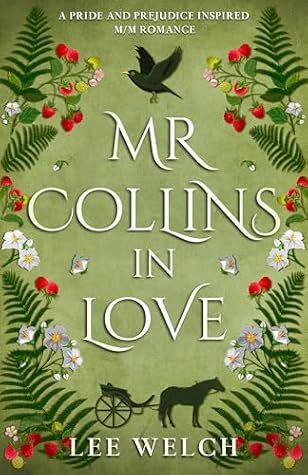
 This is a really odd little book. I love the idea of Mr Collins being gay, and I can only admire the ingenious way the author weaves this idea into the actual events of Pride and Prejudice. It’s just a pity that it doesn’t work terribly well.
Here’s the premise: the setting is the year of Mr Collins’ ordination at Easter and his acquisition of the living of Hunsford by the patronage of Lady Catherine de Burgh. Mr Collins is finding it all a bit stressful, and here’s where the author’s talent shines through. Our hero is portrayed on the outside as the bumbling clergyman of the book, with his carefully contrived compliments to the ladies, but since we see his inner thoughts, we see all his uncertainty. He agonises over every move – is it the right, the proper thing to do? How will it look to his servants, his parishioners, his patroness? What do they expect of him? There’s some conflict here between his inner timidity and the unstoppable arrogance he displays in P&P, but never mind.
But then something even more unsettling than Lady Catherine appears – a friend from Mr C’s youth, a labourer called Jem, on the run from the naval career he hated. Mr C gives him a job, they settle back into their former friendship and it soon becomes clear that there’s a sexual element to it. Not that they ever so much as touch each other, but there are some private moments involving naked bathing in a well-hidden pool, and it is a bit graphic so avoid if you want a completely clean read.
And then there’s the pressure from Lady C for Mr C to marry, and he has an extraordinary conversation with Jem about it. Jem fully understands that a wife would change everything, but Mr C doesn’t seem to realise quite what he means. It’s never clear whether he appreciates the requirements of marriage, or whether he’s so unworldly that he doesn’t really get it. I think the author was aiming for subtlety here, but as far as I’m concerned it was all a bit too subtle, and I’d have liked a more explicit explanation of just what he thinks marriage entails.
The next moment we’ve jumped to Longbourn, post-proposal to Lizzie, with Mr C working out how he’s going to explain her refusal to Lady C, and how long a respite this might earn him before he has to go courting again. Whereupon Charlotte Lucas begins her campaign to get him to propose to her instead. This takes some doing, and here is where his arrogance carried him along in the original. But the author having painted Mr C as a man who simply fails to understand subtext, he doesn’t get it when Charlotte says casually that she’d quite like to be married. He doesn’t take the hint, and she practically has to propose to him herself to get him to the point.
I know that Charlotte is a practical sort of girl, but this portrayal of her I found impossible to believe. In particular, her crawling declaration that she’ll do anything he wants if only he’ll marry her (only slightly paraphrasing) throws every shred of dignity out of the window. As for telling him that they could live like brother and sister – why would she even consider the possibility? That is the purpose of marriage in Regency times. She can’t possibly have any inkling of his feelings for Jem, because I doubt any well brought up lady would know that was even a possibility. So this part of the book didn’t work at all for me, and what is more, it serves to sweep away the last vestige of tension.
Mr C returns triumphant to Hunsford, Jem is pleased, Charlotte gains the respectable establishment she wants and they all lived happily ever after… or did they? No indication of that. There are so many potential problems that it seems like cheating to end at that point. Did Jem and Mr C ever go further? Did they ever talk about love? Did anyone ever find out? How did Charlotte cope with her rather lonely existence? And (the most worrying element, to my mind) how did Lady C react to the non-appearance of children? Undoubtedly she would haul Charlotte off to a physician who would reveal the awful truth and then Mr C would be in trouble.
To be honest, this story would have been more interesting, I think, if it had started after Mr C and Charlotte were married and then Jem arrived. That would have developed some proper tension. As it is, I did enjoy the book, up to a point, but I can only give it three stars.
PS An unexpected side effect of this book is that Amazon is now recommending swathes of gay romance books to me.
Leave a Reply