 I’ve enjoyed previous Sophia Holloway books, but this one was just too dull for words. Both hero and heroine were too unbelievably good, without a single flaw between them, the villain was over the top and there was an adorable moppet of a child who rendered everyone around her saccharine sweet. And nothing very interesting happened.
Here’s the premise: Louisa, Lady Dembleby is relieved to find herself widowed and unexpectedly free from a marriage which she’d hated. Having failed to produce the expected heir, she takes her small daughter and returns to live with her parents, an odd choice for a widow, but never mind. Her parents seem to think they have some hold over her, but they really don’t. She’s independent, and can do what she likes, if she has the money.
That’s another odd aspect of the situation. Louisa apparently gets one third of her husband’s estate after his death by law, which is true, up to a point. If a man leaves no will, or fails to mention his wife in his will, that is indeed what she gets. But by the Regency, it was almost universal for wealthy men to agree to a settlement for the wife before marriage, which could be for a lot less that a third of the estate. In this case, there is already a dowager, and if she also got a third of the estate, that would leave only one third for the new inheritor of the estate. And if he died and left a widow to take another third of the estate… well, silly situation, but you get the point.
Anyway, it all becomes moot because Louisa fortuitously inherits an estate which she moves to and updates to make a cosy home in the country with her daughter, and then, for some reason I’ve forgotten, she moves to Bath. She’s determined not to marry again, but then she meets Major Benfield Barkby, who was wounded in the hostilities in Spain. Many people are turned off by his maimed hand, but not Louisa (whose only fault seems to be that she’s too perfect), and he, of course, suffering from a similar fault, is a big success with the cute child.
When the child suffers a serious infection, the two principals hurl themselves with unstinting devotion into nursing her back to health, a section of the book which went on far too long for my liking. And then there’s a villain, some foul rumours, a completely irrational decision by Louisa and (a tediously long time later) a happy ending.
There’s too much head-hopping for my taste, where the point of view character switches mid-scene, and sometimes even mid paragraph. That can be effective, but I just found it distracting. Don’t get me wrong, this is a well-written book and if you’re in the mood for two holier-than-thou characters, a sickly sweet child and an over-the-top villain, go for it. For myself, I like my characters a touch more real-world than this. There were plotting issues that niggled away at me, too, like the money issue. I could accept the third of the estate business or the unexpected inheritance, but both seemed too much. And why move Louisa to the inherited house and then to Bath? Why not go directly to Bath? All in all, these issues keep it to three stars for me.
 Oh, the joy of discovering a new Joyce Harmon book! This series is just so much fun, and this episode, although somewhat gentler than some of the previous books, is still a delight. Still no sign of the handsome lord (and battle mage!!) I’ve been hankering after for several books now, but there is some potential love interest for our heroine.
 As always, a wonderful read from one of my favourite writers, with a very unconventional hero and heroine, a lovely slow-burn romance and a villain thoroughly redeemed.
 A curious little book with so little substance that it feels as light as thistledown. If I don’t write a review on the spot, I shall have forgotten the whole thing by tomorrow.
 This is a follow-on to Althea, which I loved. This isn’t quite so good, being a bit scattershot, but still a pretty good read.
 An intriguing read by a new-to-me author, with a fascinating hero and heroine. The focus is very much on the two principals, so there’s not much else going on, and the background is the conventional season and all the usual events, but if you don’t mind a bit of sex in your Regency, this is a pleasant read.
 This one was a joy to read. The exchanges between hero and heroine are genuinely witty, both are interesting characters, the side plots are realistic and it’s beautifully written.
 I enjoyed this up to a point, but I found it by far too wordy, with too little actual plot and too much philosophical wrangling.
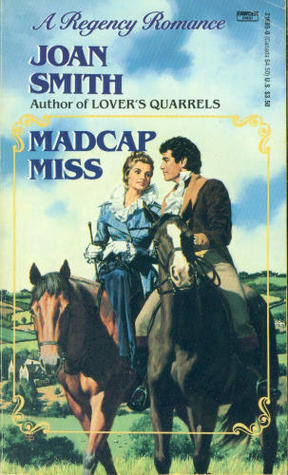 This was a whole heap of fun! I despise plots where the heroine disguises herself as a boy, but this one masquerades as a child, leading to all sorts of entertaining results, like being given warm milk to drink instead of wine, and being expected to play with skipping ropes and dolls! A very original story.
 An oddly disjointed book, which I found difficult to get into, although I’m not sure why. The hero and heroine were perfectly fine, the romance burbled along nicely and there was a great deal of Regency restraint and propriety on display, which is all estimable. Yet somehow I was unmoved.