Author: Mary Kingswood

Review: The Road Through Rushbury by Martha Keyes (2020) [Trad]

Posted July 24, 2020 by Mary Kingswood in Review / 0 Comments

A new Martha Keyes book is always a thrill, and this one was another excellent read, a gentle, straightforward romance set away from the usual Regency settings of London, Bath and great country houses in a very small village in Yorkshire. It has one of the best opening lines I’ve come across in the genre: ‘Ten thousand. That was the number of pins Georgiana Paige estimated she’d had stuck in her hair since her coming out eight years ago.’ And there in a nutshell is the premise for the story. After eight seasons in the marriage mart of London, Georgiana is firmly on the shelf. When an opportunity arises, she accepts her spinsterhood, abandons the London season to her younger sister and decamps to become a companion to her aunt in Yorkshire.

The setting is very different from anything she’s experienced before, and initially she encounters suspicion and outright hostility from the villagers, but she rises to the challenge and, having criticised the state of the roads in the neighbourhood, volunteers to become the local Surveyor of Roads, and see about putting them right. Her guide in this endeavour is the local vicar, Samuel Derrick, who is one of the most overtly hostile of the villagers, having developed a great dislike of selfish gentry after a bad experience, but he is gradually won over by her determination and complete lack of the arrogance he’d expected.

The romance between them is (in my view) the best kind, where they slowly get to know each other and learn to appreciate the other’s good qualities, and this element of the book is stellar. The road-building and the interactions with the mostly wholesome and apple-cheeked villagers, particularly the hard-pressed weaver family, the Reeds, I found slow going.

I also wondered a little about the seeming glamorisation of hand-crafting, when the Reeds didn’t seem to be doing too well on it, and the demonising of the industrialisation of the industry, a process which was certainly disadvantageous to many workers, but also reduced the price of cottons and woollen fabrics, and benefited many. I would have liked to see a little more discussion of the two sides of the story (and there are always two sides; industrialisation wasn’t just about profit). But instead Georgiana instantly accepts that change is a bad thing, and the local land-owners are turned into villains for wanting to develop the village a bit.

After the halfway point, things speed up considerably, and after taking several days over the early chapters, the latter ones kept me up until the small hours, just to see how the ingenious Georgiana would resolve the difficulty and get her man, because it all seemed to be impossible for a while. The ending is a bit ‘with one bound they were free’, but it didn’t matter by that point, and the romantic denouement was delightful, with a nice twist to it.

If I have a complaint at all, it’s that the two main characters were a bit too perfect. Samuel had his prejudices, but otherwise he seemed to spend his life helping the poor and preaching well-received sermons, while Georgiana seemed to have no visible flaws at all, winning over all the villagers (with the possible exception of Lady Whatsit at the big house!). She was just a thoroughly nice person, and I would have liked to see a bit more fire from her. It would have been nice to see more of the aunt, too, who seemed to be merely a convenient plot device to draw Georgiana to Rushbury and then be more or less ignored. I do think she could have done more to intervene when the crisis hit and Georgiana was obviously very unhappy.

As always with Martha Keyes, this is a beautifully written tale. My favourite line was this, of clouds: ‘inching along at the leisurely pace of clouds that had nowhere to go.’ The research was excellent (I never knew there was such a post as Surveyor of Roads), and the romance is lovely. Not the most dramatic read ever, but very enjoyable nevertheless (it reminds me a bit of Lark Rise to Candleford, where nothing much happens very slowly, but in the most pleasant way). Four stars.

Tags:


Review: Playing With Fire by Jayne Davis

Posted July 10, 2020 by Mary Kingswood in Review / 2 Comments

Well, that was awesome. Jayne Davis is my favourite kind of author, partly because I never know what she’s going to come up with next and partly because she allows the story to expand and grow and unfurl its petals in whatever way feels right. So many authors constrain their characters to conform to the needs of the plot, but Davis’s tales always feel completely natural and organic, as if they were always meant to be. This one starts with a tense escape from revolutionary France, morphs into a first London season, complete with visits to the mantua-maker, drives in the park and assorted suitors, veers off into a brilliantly funny piece of trickery worthy of Georgette Heyer, lurches back into tension again and then ends with a delicious romantic denouement. Utterly wonderful.

Here’s the premise: Phoebe Deane is the little-regarded poor relation, living with her aunt and uncle, who are French emigres. When her aunt and cousin decide to return to their chateau to recover some possessions, Phoebe accompanies them, but it’s 1793, the revolution is in full swing, aristocrats are not welcome and Phoebe can’t make her aunt understand the urgency of escaping as quickly as possible. Her aunt’s arrogant manners soon get them into trouble, but they find help from an unlikely source.

Alex Westbrook finds himself drawn to help the family, even though it might hamper his own secret mission in France. But he finds that Phoebe is quick-witted and resourceful enough to be a trusted ally, and more than willing to take risks when necessary. So begins an unlikely friendship, but can it ever be anything more? Well, we can guess the answer to that, but there’s a long and winding road to reach it.

I confess that for the first few chapters, I wasn’t sure I was going to like this book. The difficulties in France are so intense and so relentless, that it almost felt like Game of Thrones. What horrible event was coming next? Even though I knew that the protagonists would survive (because romance) it was a little too intense for comfort. However, once Phoebe reached London and dived into the more familiar ground of preparations for the season, it was a lot more comfortable. Phoebe’s a fantastic character – smart and plucky, with a ton of initiative. Sometimes she seemed almost too smart, and a bit too lucky, but that was OK. Alex – well, who could not like Alex? A great hero, who risks everything to save the mysterious redhead, and treats her like a real person not a helpless female who needs a man to tell her what to do and to protect her.

Of the side-characters, some we’ve seen before (this is the third book in the Marstone series), although it’s not necessary to have read them all. I very much like that the three books are spread out over about twenty years, so this one acts as an extended epilogue to the earlier books, for those who enjoy such catchups. The new characters tended to fall into the helpful yokels or villainous villains categories, although some were just plain irritating (Comtesse de Calvac, I’m looking at you). Phoebe’s uncle, the Comte, who had been distant and uninterested before, suddenly and implausibly becomes a sort of fairy-goduncle to Phoebe, and naturally the dowdy poor relation instantly becomes an attractive and desirable potential bride. This was great fun.

But of course, things soon go pear-shaped and we’re off into all sorts of unexpected twists and turns, and all the time the romance is simmering on the back burner, never ever forgotten and gradually coming to the fore. The ending is lovely and perfectly in keeping with the various characters involved, and if some things seemed unnecessarily convoluted, it was all too much fun to quibble over. The only slight complaint I have is that towards the end, some of the dramatic events happen off-screen. I would like to have seen them up close. But it’s a trivial point.

A wonderful read, whether you like thriller-type tension, something more traditional or a quirky mixture – this book has it all! Not to mention a lovely romance, with some swoon-worthy kisses (and nothing more than that). As always with this author, the writing is top-notch with an effortless evocation of the era, in both England and France. Five stars.

Tags:


Review: A Suitable Match by Jayne Davis

Posted July 10, 2020 by Mary Kingswood in Review / 0 Comments

Jayne Davis is an interesting writer. Every book she writes is different, and I love that sense of not knowing what I’m going to get when I fire up the Kindle. Her debut, The Mrs MacKinnons, was sharply original and darkly funny. Sauce For The Gander was a more conventional romance with a strong helping of boy’s own adventure. An Embroidered Spoon had the unusual setting (for a Regency) of Wales, coupled with an uncompromising view of the stifling life of a young woman in the era. And here we are with another switch, a straight-down-the-line tale of the kind that Georgette Heyer fans love – fancy gowns, balls, rides in the park, matchmaking and all the paraphernalia of the London season, with a spying sub-plot. It’s all great fun, and if I slightly miss the out-there originality of The Mrs MacKinnons, this is still better than 99% of Regencies on the market these days.

Here’s the plot: Lady Isabella Stanlake is the youngest daughter of the Earl of Marstone. Her sisters and her brother are all married, so now it’s her turn, and her overbearing father isn’t about to give her any freedom to choose for herself. She’ll marry someone he thinks suitable, and there’s an end to it. Her aunt is bribed to bring her out and make sure she toes the line. Fortunately, Bella is a smart and enterprising young lady, and manages to make the most of her season while avoiding the most hideous of the potential husbands on offer.

Her brother would help her find someone to her liking, as he did for her older sisters, but he’s called away on secret business and so he asks his friend, Nick Carterton, to keep an eye on Bella and help her out if she gets into trouble. Nick is dutifully looking for a wife, so he’s doing the season too, and it’s no problem to look after Bella, especially as she turns out to be far more interesting than the terribly dull and worthy young ladies he’s picked out as possible brides. Nick didn’t light any fires for me, but he’s a steady and honourable young man, and if that sounds ever so slightly dull, it also makes him a more realistic hero than most found in modern Regencies.

Alongside the main story were a number of side plots involving spying, blackmail and a man in disguise, plus an intriguing glimpse of the unpleasanter side of Regency life, involving a seamstress who loses her job. Kind-hearted Isabella sweeps in to rescue her, in the process discovering just how difficult life can be for those at the bottom of society. This sort of story teeters on the edge of imposing modern sensibilities on the world of two hundred years ago, but Davis manages to make Isabella’s benevolence believable. Bella’s extremely sheltered upbringing, bordering on imprisonment, means that she has an unsullied if naive approach to the sophisticated world she now finds herself in, and her intelligent if slightly wayward personality inevitably leads her into such situations.

The story chugs along very pleasantly until the final stretch, when all sorts of mayhem breaks out and things get quite dramatic. Bella’s efforts to escape her fate were ingenious (I love a resourceful heroine), but I greatly appreciated that the villains are not exactly stupid either. Kudos to the author for avoiding the trap of making things too easy for the heroine. And then there’s a delightfully twisty ending, that took me very much by surprise. Nicely done. A very well-written traditional Regency, and a good four stars.

Tags:


Review: The Dream Chasers by Melinda Hammond (2003) [Trad]

Posted July 3, 2020 by Mary Kingswood in Review / 0 Comments

Having read and enjoyed Autumn Bride, I moved straight on to the sequel, which features many of the same characters but set some twelve or so years later. It was published twenty years after the first book, so there are some disconnects (to my mind) but it wasn’t a problem.

Here’s the premise: wild boy Vivyan Lagallan has reached the grand old age of thirty and decides it’s time to settle down. He proposes to beautiful, respectable and ever so slightly dull Helen Pensford. Returning from his successful suit, a very different sort of lady drops (literally) into his arms, Miss Eustacia Marchant. She’s running away from home in pursuit of the man she’s fallen in love with, Rupert Alleyne. To make things easier on her illicit journey, she dresses in boy’s clothing, but gets into difficulties and ends up stuck in a tree, from which position Vivyan manages to rescue her. And if you think this sounds vaguely familiar, then you’ve probably read Georgette Heyer’s The Corinthian, which has a very similar opening (with shades of Sprig Muslin thrown in, for good measure).

Eustacia is an innocent, and determined to make her way to London, so Vivyan, the reformed wild boy, turns gentlemanly protector to help her to get there safely and without scandal, and then keep an avuncular eye on her. This is a very different Vivyan from the irrepressible scamp of the earlier book. He’s still charming, but now he falls into the role of slightly jaded man-about-town, almost the world-weary older man found in so many Heyer books. It isn’t a problem, but reading this straight after the previous book, it was a bit of a shock.

Needless to say, Rupert Alleyne, the object of Eustacie’s affections, is astonished to find that his casual flirtation has assumed far more serious proportions in her mind. I very much liked the way the author handled this quandary. Rupert could have become the caricature villain at this point, but instead he behaves in a far more believable way.

The plot from this point becomes the standard Regency tangle of two couples engaged to the wrong partners, and at first it seems that those oh-so-restrained Regency manners are going to prevent the happy ending the reader expects. Fortunately, Eustacia is an ingenious little soul, and the way the whole muddle unravels is great fun and (unlike a number of Heyer denouements) doesn’t depend on everyone suddenly turning into morons or forgetting to talk to each other or making wild sacrifices for the heroine’s own good.

Great fun, authentically Regency and very readable in the best traditions of Heyer. Five stars.

Tags:


Review: Autumn Bride by Melinda Hammond (1983) [Trad]

Posted July 3, 2020 by Mary Kingswood in Review / 0 Comments

This is a short read from a new-to-me writer, one of those who’s been publishing for some years and the earlier books are now available on Kindle. This one was first published in 1983, and like many books of that era, it’s heavily redolent of Georgette Heyer. The language, the faithful Regency setting and even some plot elements recall the great lady, but that’s not a bad thing at all.

Here’s the premise: Caroline Hetton has been effectively abandoned by her mother and her family since her father died, so she’s making her way in the world as a governess, a pretty thankless task in those days. Out of the blue, she’s offered a way out of this situation. A former neighbour has left a property to her heir, Vivyan Lagallan, with the stipulation that he won’t get it until he’s twenty-five, unless he marries sooner. And the will explicitly mentions Caroline as the bride, or another lady equally suitable. It’s hard for a mere governess to turn down such a beneficial opportunity, so Caroline agrees to visit the heir to see if they would suit.

All this is managed by the heir’s older half-brother, Major Lagallan, a stolid, steady sort, very different from the free-spirited Vivyan, who’s reminiscent of Heyer’s character Richmond of Unknown Ajax, or perhaps Ludovic of The Talisman Ring. It’s Vivyan, naturally, who leads everyone into trouble through his reckless ways, but he’s so charming that it’s impossible to dislike him. And while he’s stirring up trouble, Caroline and the stolid major are both realising that perhaps she’s marrying the wrong brother. How they resolve the tangle is the question, and I have to say it’s managed very neatly, if a little implausibly, and with a completely heart-stopping moment along the way. Cleverly done!

The romance is low-key, but that’s in the best traditions of Heyer herself, so I won’t grumble about it. Unlike some reviewers, to me it was always obvious how things were going and to my mind the slowly developing change of feelings is signalled quite clearly, if undramatically. An excellent read in the traditional style, with a great Regency feel. Five stars. You can find this book as part of a ‘four seasons’ boxed set, and if you like Melinda Hammond’s style, she also writes as Sarah Mallory.

Tags:


Review: Friendship and Folly by Meredith Allady (2004) [Trad]

Posted June 23, 2020 by Mary Kingswood in Review / 0 Comments

This book is a classic example of how much the author’s choice of approach changes the final result. The novella-length prequel to this series, Letters From Bath, was written (not surprisingly, given the title) in an epistolatory style, so the personality of the letter-writer shone through in every word, every charmingly acerbic phrase. It was sharply witty and I absolutely adored it.
This, on the other hand, was written in a laboured narrative style, complete with direct-to-reader interjections, and even though the wit and rapier-sharp use of language were still there, it felt heavy and (frankly) dull. There were moments when I practically fell off my seat laughing, just as before, but there were also long turgid passages where I almost lost the will to live, and whole lengthy paragraphs that I honestly couldn’t make head or tail of, even though I struggled manfully to disentangle the writhing sentences. But still, I finished it and there were parts I loved.

The story follows the Parry family, an eccentric and quite astonishingly clever family, to London for the season, to bring out the eldest daughter and beauty of the family, Julia. Along too goes Ann Northcott, the letter-writer from the previous book, and so much a friend of the family that she’s almost a Parry herself. They also take all the children and another hanger-on (whose name escapes me, since he was one of a cast of thousands). Now, this may be about the season in 1805, but there’s nothing about clothes (apart from the court dress) or Almack’s or drives in the park or any of the usual settings. The whole book seems to be a backdrop for the oh-so-clever wit of the Parry family and Ann Northcott.

There’s a plethora of side characters, but the principals are Sir Warrington Lenox and his younger brother, Mr Edmund Lenox, from Ireland, who are truly an odd pair. Sir Warrington Lenox is very redolent of Dolph from Georgette Heyer’s Cotillion, in that he appears to be mentally deficient after reportedly being stolen as a child and raised by gypsies. The younger brother actually believed he was an only child and it wasn’t until his father died and he supposedly inherited the baronetcy that he learnt about his older brother. Now Sir Warrington has come to England to find a bride, and his brother has come along too. Sir Warrington develops a liking for Julia and attaches himself to the Parrys, and they are amenable to said attachment. And so the tale meanders along. I almost said plot, but really, there isn’t one, just a series of settings in which the Parrys can show off their terribly clever turns of phrase.

It should be obvious by now that this is very much not your run-of-the-mill Regency romance. There is a romance, but it’s practically offstage and everything about it is interpreted through the biased eyes of Ann. In fact, it’s so low-key you might very well miss it altogether if the narrator hadn’t stopped and pointed it out. As with other elements of the story, it’s completely hemmed in by the perfect selflessness of the main characters, who are just too considerate of other people’s feelings to be totally credible.

I’m going to be honest and say that this book wasn’t really my thing. It’s too long, too wordy, too convoluted and very often too show-offy clever for its own good. But that’s just me. While I struggled with large parts of it, I acknowledge that it’s incredibly well-written, it feels utterly authentic as a Regency novel and if you’re the sort of reader who wants to sink into a warm scented bath of delicious wordsmithery, then this might very well make you squeal with delight. If, on the other hand, you’re like me and want a proper plot and characters who aren’t selfless bundles of virtue, you should probably avoid it. Three stars.

Tags:


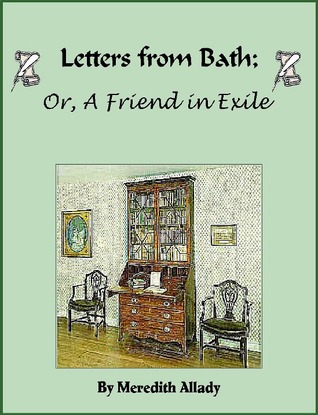
Review: Letters From Bath by Meredith Allady (2012) [Trad]

Posted June 23, 2020 by Mary Kingswood in Review / 0 Comments

This book is so funny! I laughed so hard sometimes that I actually had to stop reading for a while. It’s beautifully written in a very credible Austen-esque epistolatory style, with the same biting wit, but be warned: it’s nothing like an adjusted-for-modern-readers regular Regency. A number of reviews complain about wordiness and dense prose, so it won’t suit everyone, but anyone who enjoys that style will be rewarded with a gentle and very nuanced tale.

The other main complaint is that there is no plot, and while that’s not quite true, I understand why readers would feel that. This is not a romance, and it’s a very undramatic story, to put it mildly. In fact, the entire plot can be summarised in this sentence from the blurb: “Ann Northcott reluctantly accompanies her mother to [Bath], and there finds what entertainment she can by plotting various subtle ways in which to be disobliging, indulging in unskilled matchmaking, and writing accounts of it all to her best friend Julia.” That’s it. But within those letters to Julia are gloriously funny descriptions of the various characters Ann meets, of her machinations on their behalf and of her own gloom at her enforced stay in Bath. She dislikes the city so much that she fantasises about inviting the French to come and destroy it, although she would also invite the English troops to get rid of the French again after this was done.

Yes, it’s a lightweight little story, and rather short, but it’s very, very clever for those who can stomach the authentically Regency writing style. I absolutely loved it. Five stars.

Another warning: this is a prequel to the Merriweather Chronicles, but a number of reviewers suggest that it’s actually better to read book 1 of that series (Friendship and Folly) first. I haven’t done that, but I’m going straight on to F&F, and may come back and reread this one afterwards (it’s short enough and funny enough that it would be no chore).

Tags:


Review: The Courtship of Chloe by Dorothy Mack (1992) [Trad]

Posted June 22, 2020 by Mary Kingswood in Review / 2 Comments

I loved this book. It was first published in 1992, so it’s a solid traditional Regency, and nothing about it was earth-shatteringly original, but it was beautifully written, with well-drawn and sympathetic characters, and a nicely developed romance. Anyone pining for a new Georgette Heyer would find this a satisfactory substitute.

Here’s the premise: Chloe Norris is a down-to-earth doctor’s daughter, sent by various circumstances to help out the Keeson family who are planning a ball to celebrate the forthcoming marriage of younger daughter Lady Mary. It seems a simple enough business, but Chloe finds herself thrust into the midst of awkward family tensions. Matriarch Lady Montrose is superficially friendly but ruthlessly domineering. Lady Mary is curiously uninterested in her marriage. Older sister Patricia is sunk in grief for her recently deceased husband, ignoring her daughter Emilie. Younger son Ned Keeson is an outrageous and determined flirt. And then there’s Ivor, the eldest son and Earl of Montrose, who seems very drawn to Chloe. But Chloe’s betrothed to navy man Captain Bertram Otley, so that will protect her from unwanted advances, won’t it?

Chloe’s arrival is the pebble in the pond that sets ripples in motion. She starts by making friends with the sadly neglected little girl Emilie and gradually draws both the sisters out of their self-absorption. And Ivor finds her a refreshing change from the women in his usual circle of acquaintances. Chloe has no drawing-room accomplishments, apart from an ability to sew a hem, but she’s well read and intelligent and can hold her own against him over the chessboard. He holds himself aloof from the world, burying himself in estate work and physical labour with his workers, but Chloe draws him out of himself.

Now, apart from Chloe’s engagement, which has been in existence for five years and must therefore be presumed to have run aground, there’s absolutely no obstacle to these two getting together whenever they please. Ambitious Lady Montrose doesn’t like it, of course, but Ivor’s a grown man in full possession of his fortune, so that really isn’t a problem. Somehow, however, the romance chugs along at the speed of treacle (molasses for US-ians), with Chloe trying to keep her head down and not tread on any snooty matriachal toes, Ivor gradually making up his rather sluggish (in emotional matters) mind and said matriarch lobbing hand grenades at them.

Chloe, it has to be said, is something of a Mary Sue, in that pretty much everything she does turns out well, she never blows her top or walks out in a huff or shows the slightest crack in her perfect Regency ladylike composure. Even when she gets into trouble by allowing Emilie to get caught in a downpour, it’s because she was so engrossed in entertaining the child. She is just a tad too perfect, but still a very sympathetic character as just about the only normal (and unselfish) person in the whole household.

Ivor is a more believable character, that staple of the Regency novel, the silently brooding nobleman. I disliked his utter obliviousness to his sisters’ unhappiness, and his rather cowardly way of hiding away from his mother. He was also pretty arrogant in assuming that Chloe’s engagement would easily be set aside for him. He was so confident of success that he told everyone that he was going to marry her before he even proposed – and this to a woman already betrothed!

Of the other characters, Lady Montrose is a bit of a cliche, the snobby, ambitious and manipulative mama, but very well-drawn and never losing her smarmy outward appearance until the very end. The two sisters lacked backbone, especially Mary. I usually have very little time for characters who realise they’re making a hideous mistake but are quite prepared to go ahead and make it anyway, but in this case I totally got the point that it was easier just to give in and do what was expected rather than fight it out with mama. Patricia is slightly over the top, but still a believable woman quite overcome by grief. Ned is also slightly over the top as the irrepressible flirt, but even he is so terrified of his mother that he resorts to extreme (and ungentlemanly) measures to thwart her matchmaking. The writing is excellent, with just the very occasional Americanism, although I laughed so hard at the settee in the rose garden! No, just no.

In the end none of these minor quibbles mattered at all, since I was totally swept up in the story. It’s not profound, but it’s a charming traditional Regency with a range of interesting characters and a very satisfactory romance. Five stars.

Tags:


Review: The Wicked Husband by Mary Lancaster

Posted June 20, 2020 by Mary Kingswood in Review / 5 Comments

Yet another cracking read from Mary Lancaster. There are a lot of familiar themes here – a rake reformed, an elopement, the downtrodden poor relation who’s been in love with the hero for years, a former mistress and a whole heap of duels. In other hands these could be tired old cliches, but the author makes everything fresh and fun.

Here’s the premise: Willa Blake is the aforementioned downtrodden poor relation, treated as an unpaid servant and subject to routine humiliation from her cousin Ralph. And this is how she bumps into the hero, for Lord Daxton (Dax) is in the middle of a monumental gaming session with Ralph, who’s losing badly. He sends for Willa to bring him a purse of money, and then insists she stay and watch, while all around there are wild, drunken men and borderline anarchy. It’s not a place any gently brought up young lady should be. Our hero Dax recognises Willa and despite being roaring drunk, chivalrously wants to protect her. When he’s won even the extra money from Ralph, he takes Willa away from the scene and somehow decides he’ll marry her. They end up heading straight for the border, being married over the anvil at Gretna and heading for home. Whereupon Dax, having been up gambling for three nights straight, falls into a sound sleep. When he wakes up, he’s a bit hazy about what happened…

I really liked Dax. Rakes are always charmers but they can also be selfish beasts, too, and Dax epitomises the type. Once he’s been reminded that he’s married, he decides he quite likes it and squires Willa about town, buying her new clothes and enjoying showing her off to everyone. But of course there are wobbly moments too, and he’s somewhat tested when both his former mistress and his mother turn up, determined to have the marriage annulled. Fortunately Willa is a delightfully pragmatic bride, not at all phased by his hungover rages. Of course, knowing that he only married her on a whim, she can’t possibly tell him that she’s been in love with him for years, so she suffers in silence through all the shenanigans going on on the background, including was it three duels? Good grief.

I have to say that I wasn’t entirely convinced that Dax would manage to stay contented and faithful for the rest of his life, but that’s the universal problem with rakes – do they ever truly reform? I could very easily believe, though, that he himself believes it at that moment. He intends to be faithful, so perhaps he’ll manage it.

My only grumble on historical accuracy grounds is that, despite all the talk of an annulment, it was incredibly difficult to get one in the Regency, and since one of the characters actually explains the point, I was a bit confused as to why it was even an issue. Beyond that, the writing is pretty accurate to the period. There is some lusting and a small amount of graphic sex, for those who are concerned about that.

As so often in this series, Mary Lancaster has created a likable but slightly bad-boy hero, a demure and downtrodden heroine and a fun, if implausible, adventure in the background. It’s an entertaining romp, very funny and highly recommended. Five stars.

Tags:


Review: The Talisman Ring by Georgette Heyer [Trad]

Posted June 18, 2020 by Mary Kingswood in Review / 1 Comment

Why, why, why have I never read this before? This must surely be the wittiest ever Heyer, one where, astonishingly, all the characters are equally fun, from the reckless ingenues to the main couple to the side characters. It has echoes of familiar scenarios and characters (or rather, they have echoes of this work), but it is scintillatingly itself.

Here’s the premise: Sylvester, old Lord Lavenham, is dying, and his final wish is for his French granddaughter, Eustacie, to be taken care of, and the best way to do that is for her to marry one of her cousins. Basil is out of favour, Lord Lavenham’s heir, Ludovic, fled after a murder, and so the honour falls on the baron’s great-nephew, Sir Tristram Shield. He doesn’t mind. He’s thirty-one and has to marry sometime, after all, and Eustacie’s pretty enough. She’s a bit wilful and very French, but she accepts the idea, too, and they’ll learn to get along together, won’t they? But an evening together convinces Eustacie that he’s too boring and unromantic to be husband material, so she runs away, thereby setting in train a whole swathe of interesting (and very funny) consequences.

It’s froth, of course, as so many Heyers are ultimately, with smugglers, secret passages, a villain who was obvious from the start but wasn’t at all the moustache-twirling type, and a rather clever denouement. Along the way, it’s a gloriously funny adventure and not one but two satisfactory romantic pairings, although (and this is my main complaint with so many Heyers) the main romance is pushed aside rather in order to give the adventure time to shine. In fact, the secondary romance is almost better developed.

However, this didn’t detract too much from my overall enjoyment. I loved all the characters, especially the pragmatic Sir Tristram, this-is-fun Sarah Thane, over-romantic Eustacie, charmingly reckless Ludovic and (perhaps my favourite character) the wine-loving Sir Hugh, perfectly willing to ignore the shenanigans going on all round him, until the precious wine cellar was threatened! Possibly my new all time favourite Heyer. Five hundred stars, at least.

Tags: