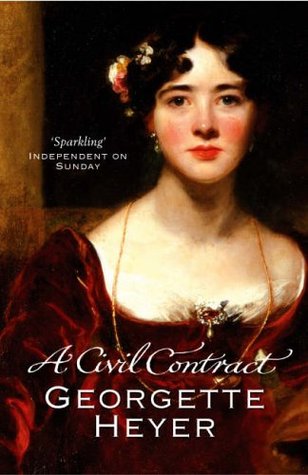
 This is an amazing book. Not only does it have Heyer’s trademark range of eccentric characters and humour, but it has an emotional resonance unusual for this style of book. The root problem is one that’s bothered me, too, as I write my own Regency romances – what would a marriage of convenience really be like? Modern folk are so accustomed to the idea of romantic love matches that we can’t quite get to grips with the reality of a pragmatic, loveless marriage of near-strangers. It would have been easier for the wealthy, with their separate bedrooms and almost separate lives for men and women, and the formality of Regency manners would have helped, but even so, most modern Regencies gloss over the difficulties. The hero and heroine have a few dust-ups before deciding that, actually, they’re in love after all, so cue the violins. But I wonder just how likely that would be.
Here’s the premise: Adam Deveril is summoned home from his soldiering on the continent when his father dies. He discovers to his horror that the estate is virtually bankrupt. His mother’s portion is secure, but there’s no money for a season for his sister, or a dowry, and even the treasured family home will have to be sold. There’s just one way out – to marry a wealthy heiress, selling his viscountcy to the daughter of some upstart city merchant. And here Heyer adds the cruel twist that gives the book so much of its emotional depth – such a marriage, while it saves Adam and his estate, would destroy for ever his chance of marrying the love of his life, the beautiful, if highly-strung Julia Oversley.
Through Julia’s father, Adam is introduced to the plain and shy Jenny Chawleigh, and even her name is dowdy (her given name is the much prettier Jane, but everyone calls her Jenny). She’s been well educated, so her manners are good, but her style of dress is of the ‘more is more’ type, with lace and flounces and jewels dripping everywhere. And here is one of the most interesting elements of the book – the culture clash between Jenny’s wealthy but uncultured upbringing and Adam’s far more refined background in the upper echelons of society.
The epitome of this culture clash, of course, is the character who towers over the book, dominating every scene he is in – Jonathan Chawleigh, the extremely wealthy ‘cit’ (a banker, industrialist or merchant from the city of London), Jenny’s rough and ready father. Mr Chawleigh knows perfectly well that he won’t fit in with Adam’s upper class friends, and assures him he will keep out of the way. That doesn’t stop him from stepping in to splash his money about on his behalf. When Adam decides to sell the family’s town house, Chawleigh secretly buys it and has it refurbished to his own vulgar taste while the newly weds are on honeymoon. Such episodes are a sore trial of Adam’s good manners.
All of this is delicious, and very funny, but the real heart of the book is the slowly developing relationship between Adam and Jenny, and the parallel choices of his cast-off love, the melodramatic Julia. Many readers find Adam and Jenny’s story a sad one, the surrendering of intense romantic love for the quieter affection of shared interests and a comfortably placid life. I think it’s a beautiful realisation of the joy of a real marriage, one that’s fuelled by genuine affection rather than the fireworks of instant attraction. Love, rather than infatuation. A wonderful and thought-provoking read. Five stars.
 What is there to say about this that hasn’t been said a thousand times already? This is the definitive version, the Colin Firth and Jennifer Ehle version, the diving-in-the-lake version, the one that spawned a whole new love affair with Jane Austen and a spate of new dramatisations and inspired-by films, books and TV productions. I’ve been rewatching it for the fourth or fifth or sixth time, and enjoying it just as much as before, perhaps more so now that I know a little bit more about the Regency era than I did. Here are some random thoughts.
 This was a disappointment. The premise is fun, if not wildly original (it’s basically the plot of Georgette Heyer’s Arabella, with a few minor variations), but the execution is not all it might be. The characters have some charm, but the writing lacks lustre, with dialogue that feels too modern and a number of historical inaccuracies.
 Well, Hugo’s a charmer, and no mistake. Coming to this directly after Venetia is a bit of an eye-opener, for the contrast between sophisticated rake Damerel and straight-down-the-line Hugo could hardly be more marked. The leading ladies are very different, too, but whereas Venetia leaps off the page in all her self-assured glory, Anthea is very much a minor note to Hugo’s symphony. For this book is all about Hugo, make no mistake.
 Here’s the premise: Nell’s father has died suddenly, her brother has disappeared and is believed dead on his way home from India, and her mother is away with the fairies much of the time. Meanwhile, her uncle is mismanaging the estate, the money for Nell’s season has vanished and the only suitor is one she wouldn’t dream of accepting. And then a mysterious stranger arrives, and starts behaving in an odd manner. What’s a girl to do? Why, resort to deception and subterfuge, that’s what.
 Hooray for a heroine who is smart, resourceful and knows her own mind right from the start! So many of Heyer’s heroines somehow don’t recognise their own feelings until the hero sweeps them into his manly arms and kisses them thoroughly, but Venetia is not of that type. She sees her soul-mate in Damerel almost at once, and isn’t the slightest bit deterred by his rakish past. In fact, at the end of the book, her urgency in wanting to get back to him is as much driven by fear that he will take another mistress as anything else.
 One of the things that Mary Balogh does brilliantly is to take a wildly unusual situation, toss her characters into it and leave them to sink or swim accordingly. In this case, Rosamund and Justin meet entirely by chance on the road in the middle of a snowstorm. She has just quarrelled with her brother and sets out to walk – somewhere, anywhere. He is trying to recover something from a planned week of pre-wedding debauchery where all the other participants have cried off. They escape the snow in a hunting lodge, and, since she’s a widow curious about sex with a younger man, and he was expecting a week of sex anyway, they retire to the bedroom pretty quickly. And then, a month later, they meet up at a house party where he is expected to propose to her niece. How very awkward.
 This book made me uncomfortable. One of the tropes I dislike intensely in any kind of book, although it’s particularly prevalent in Regencies, is the misunderstanding between hero and heroine. If the entire plot could be resolved if they just sat down and discussed it over a cup of tea, then it’s usually an epic fail for me. This book has two qualities that make it compelling despite this, however. One is that it’s beautifully written, every word pulling its weight. The other is that the mix-ups are actually believable. And the final clincher is that, given the title, this is exactly what the story is about, so it’s a bit unfair to quibble.
 1972 version: RADA has a lot to answer for. They’re the ones who produced all those cut-glass accents so beloved of the BBC and its ‘received pronounciation’, who taught actors and actresses how to enunciate on stage to catch the audience in the upper balcony. Which is lovely for a stage production, but doesn’t work at all in a TV production. Doran Godwin’s Emma grated on my ears every time she opened her mouth. She looked the part, certainly, but her voice and the lack of expression sometimes in her face all came directly from live theatre.
 2009 version: Where to begin with this? It’s a real curate’s egg of a production, some dire stuff all muddled up with flashes of brilliance. Let’s start with the brilliance.
 Oh boy (fans self). This was a sizzler and no mistake. And yet, pretty clean. There’s one actual sex scene, although very tastefully done and completely non-graphic, but the rest of it is all kisses and gentle touches. And yet… so hot.