
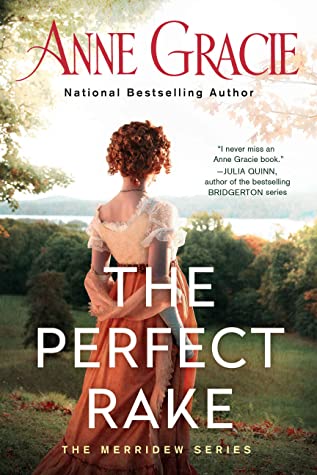
 This is one of those books that could have been a five star read, but it had weaknesses that I just couldn’t get past – too much random violence, too many clichés, too much contrariness in the heroine, too much plot manipulation on the author’s part and too detached from real life in general. But oh, the hero! A confirmed rake who falls instantly for the heroine and doesn’t swerve from that for one single second – oh, yes, yes, yes! It was Gideon alone who saved this book from three-star ignominy, and near as dammit yanked it all the way up to five stars, too. Lovely, lovely Gideon.
Here’s the premise: the Merridew sisters, aged from twenty down to ten, are living with Grandpapa after their parents died. From an idyllic life of sunshine and laughter in Italy, they’re now living a miserable and reclusive existence in the English countryside, being regularly beaten for the least transgression. Yes, this is one of those tales where the villain is excessively villainous. But when Grandpapa has a fall and is laid up in bed for a while, they take the opportunity to escape to his brother, Great-uncle Oswald, a kindly soul who lives in London.
Fortuitously, he agrees to clothe them fashionably and bring them all out, but he won’t release the beautiful younger sisters onto the world until plain eldest sister Prudence is safely betrothed. Happily, Prudence is, in fact, betrothed to Phillip Otterbury, who has been in India for four years and will come back eventually to marry her, she’s sure. But she can’t tell Great-uncle Oswald about Phillip (because reasons) so she invents a betrothal to the famously reclusive Duke of Dinstable, who lives safely far away in the wilds of Scotland. But it turns out that he’s actually in town for once, and Great-uncle Oswald is determined to go and talk to him. There’s only one thing to be done – Prudence must go and talk to him first.
And then follows one of the funniest scenes I’ve ever read, when she thinks she’s meeting the duke, but it turns out to be his rakish cousin, Lord Carradice — our hero, Gideon — who rakishly falls for Prudence, and turns his rakish attention on her. And of course she can’t help responding to all that rakish charm, only partially mitigated by the inhibiting factor of the fiancé in India. So there’s a lot of kissing and unaccustomed warmth in strange places (yes, this is not a sex-free read), followed by biffing him over the head with her reticule.
And this is basically the whole of the romance part of the plot – Gideon pursues her with single-minded determination, and a degree of charm which any normal woman would find irresistible. I certainly did, and reading the reviews, I see I’m not alone. But Prudence made a solemn vow to Phillip four years ago, and carries his ring on a chain around her neck. So even though she’s drawn to Gideon, and kisses him back with equal fervour, she’s sure he’s just fooling around with her – being a rake, basically.
This is possibly the most annoying part of the whole book. Prudence, being a sensible girl and not the flighty type, really ought to make up her mind – either surrender to that rakish charm and enjoy all those deliciously rakish kisses and unexpected warmth, or else remember her solemn vow to the absent Mr Otterbury and hold herself aloof from the kisses, warmth, etc. One kiss I can allow, since she was taken by surprise, but after that, she really has to make her mind up. But she never does, berating Gideon repeatedly for forgetting about her betrothal, while giving every sign of having forgotten it herself.
Gideon, meanwhile, is slowly and almost imperceptibly melting from irredeemable rake to utterly faithful and adoring lover, who will do anything at all for his lady. It takes him a long time to realise it, but he gets there in the end, and honestly, by the point in the book where villainous Grandpapa turns up again and Gideon swears a solemn oath to protect Prudence and her sisters from him, he is absolutely irresistible, and it makes no sense to me that Prudence doesn’t simply dispense with the absent Mr Otterwhatsit instantly.
But, for tedious plot reasons, she doesn’t, and so the book veers somewhat off the rails in the later stages. There’s rather a lot of plot manipulation going on, not least that ring that Prudence always wears on a chain around her neck, except for that one convenient time when she doesn’t. And the sisters’ sojourn in Bath is replete with coincidental meetings, and some very over-the-top melodrama. It all got a bit silly.
Happily all comes right in the end, naturally. Be warned that there is a fair bit of bedroom stuff going on by this time, so if that’s not your thing, avoid. And I have to say, I wasn’t a fan of the punishment meted out to poor Mr Otterclogs (so many delicious variations on the name!) – having been on the wrong side of unwarranted violence themselves, why inflict it on anyone else? And to treat it as a joke is out of keeping with the seriousness of what was done to the sisters.
However, this is not a book that intends to take itself seriously. It’s all a bit fairytale-ish, with a cartoonishly villainous villain, a series of spectacularly beautiful heroines (apart from Prudence) and a whole heap of implausibilities. But Gideon… Gideon totally saves the book from any hint of mediocrity. He has all the best lines, all the best moves and all the emotional moments. I honestly don’t know how Prudence could resist him for as long as she did. He may (or may not) be the perfect rake, but he is certainly the perfect hero. I recommend this book for Gideon alone. Four stars.
 Jayne Davis is one of the most reliable of the new school of historical romance authors, not because she writes the familiar themes repeatedly but precisely the opposite. She’s not afraid to step off the well-trodden paths and set her characters firmly down in unusual territory – the pre-Regency Georgian era, for one thing, far-flung parts of the British Isles for another, and the hard-working middle and lower classes. As a consequence, her books are always fascinating, and this is just the latest example.
 Jenny Hambly is one of my must-read authors, and this book was another excellent addition to her repertoire, to round off the Confirmed Bachelors series. The distinguishing characteristic of this one is the setting – most of the book is well beyond the usual run of Regency backdrops, being set on the shores of Lake Garda, and I can’t tell you how refreshing it was to be somewhere so unusual. If you’ve been to Italy it will bring back memories, and if you haven’t, you’ll be able to imagine it.
 This is another author who published Regencies back in the day, now being republished in ebook form with new covers. I’ve not encountered this author before, but I absolutely adored this book. It has a charming rural setting, a mysterious (but not too threatening) hero, a downtrodden and thoroughly deserving heroine, and a romance that builds slowly over the course of the book. And no pesky anachronisms (that I spotted).
 Every Christina Dudley book is a joy to read, and this is no exception. I’ve been looking forward to Minta’s story since she first appeared in the background of her eldest sister’s story, shooting arrows with her bosom friend Aggie, and generally getting up to all sorts of hoydenish mayhem. How was she ever going to turn into a heroine? I couldn’t wait to find out.
 My second Joan Smith on the trot and I’m finding that my palate soon becomes jaded. They are very samey, and for those looking solely for the froth of a light-hearted Heyer-esque romp, this is just the ticket, but after a while I begin to long for a bit of character development. In this one, the misunderstandings all became a bit too tangled and I just wanted it all to stop.
 This was a barrel of laughs, and although the hero and heroine get themselves into a rare old muddle through sheer stupidity, and some of the characters are a bit over the top, it’s all so funny that it doesn’t really matter.
 I read one of Elizabeth Bramwell’s books quite a while ago, and enjoyed it, so I don’t quite know why it’s taken me so long to read another but there we are. This was recommended to me as being a light read, and so it is, and very enjoyable too.
 I was a bit nervous about reading this because I’ve loved the previous books in the series, and yet this one has one feature that put me off — it’s built around a discussion of Jane Austen’s books. I can’t tell you how tired I am of authors who wheel out Austen’s books in Regencies in a sly (and frankly lazy) nudge to modern readers. However, I should have known that Martha Keyes is cleverer than that, because here Austen’s books are held up as exemplars of the despised novel, and contrasted with the more worthwhile intellectual endeavour of ancient Greek and other classic works. And even if both hero and heroine do come to see the value in Austen, there’s enough debate on other topics here that the book’s theme of reason versus emotion is beautifully illustrated. The hero and heroine play intellectual pingpong over classical works, but when they come to debate the Austen classics, they find themselves drawn into discussing their own feelings in a way that leaves them wide open to falling in love.
 Almost at once, there’s a problem. The hero, Robert, Viscount Childes, attends a ball. He’s engaged, but he appears to be having a sexual relationship with his future wife, even though he plans to take a trip to India before the wedding, a journey of at least a year. What on earth is she supposed to do if she falls pregnant, and he’s on the other side of the world? Yet he seems quite pleased with himself, and his pal thinks he’s a bit of a lad. I can’t imagine any Regency gentleman with pretensions to honourable behaviour acting that way, yet we’re told throughout the book how honourable he is.