Category: Review

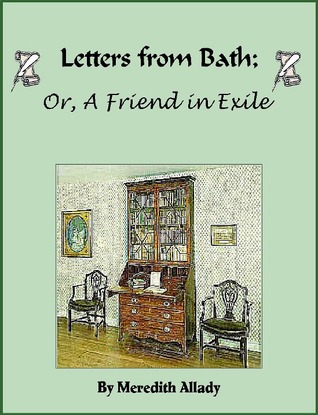
Review: Letters From Bath by Meredith Allady (2012) [Trad]

Posted June 23, 2020 by Mary Kingswood in Review / 0 Comments

This book is so funny! I laughed so hard sometimes that I actually had to stop reading for a while. It’s beautifully written in a very credible Austen-esque epistolatory style, with the same biting wit, but be warned: it’s nothing like an adjusted-for-modern-readers regular Regency. A number of reviews complain about wordiness and dense prose, so it won’t suit everyone, but anyone who enjoys that style will be rewarded with a gentle and very nuanced tale.

The other main complaint is that there is no plot, and while that’s not quite true, I understand why readers would feel that. This is not a romance, and it’s a very undramatic story, to put it mildly. In fact, the entire plot can be summarised in this sentence from the blurb: “Ann Northcott reluctantly accompanies her mother to [Bath], and there finds what entertainment she can by plotting various subtle ways in which to be disobliging, indulging in unskilled matchmaking, and writing accounts of it all to her best friend Julia.” That’s it. But within those letters to Julia are gloriously funny descriptions of the various characters Ann meets, of her machinations on their behalf and of her own gloom at her enforced stay in Bath. She dislikes the city so much that she fantasises about inviting the French to come and destroy it, although she would also invite the English troops to get rid of the French again after this was done.

Yes, it’s a lightweight little story, and rather short, but it’s very, very clever for those who can stomach the authentically Regency writing style. I absolutely loved it. Five stars.

Another warning: this is a prequel to the Merriweather Chronicles, but a number of reviewers suggest that it’s actually better to read book 1 of that series (Friendship and Folly) first. I haven’t done that, but I’m going straight on to F&F, and may come back and reread this one afterwards (it’s short enough and funny enough that it would be no chore).

Tags:


Review: The Courtship of Chloe by Dorothy Mack (1992) [Trad]

Posted June 22, 2020 by Mary Kingswood in Review / 2 Comments

I loved this book. It was first published in 1992, so it’s a solid traditional Regency, and nothing about it was earth-shatteringly original, but it was beautifully written, with well-drawn and sympathetic characters, and a nicely developed romance. Anyone pining for a new Georgette Heyer would find this a satisfactory substitute.

Here’s the premise: Chloe Norris is a down-to-earth doctor’s daughter, sent by various circumstances to help out the Keeson family who are planning a ball to celebrate the forthcoming marriage of younger daughter Lady Mary. It seems a simple enough business, but Chloe finds herself thrust into the midst of awkward family tensions. Matriarch Lady Montrose is superficially friendly but ruthlessly domineering. Lady Mary is curiously uninterested in her marriage. Older sister Patricia is sunk in grief for her recently deceased husband, ignoring her daughter Emilie. Younger son Ned Keeson is an outrageous and determined flirt. And then there’s Ivor, the eldest son and Earl of Montrose, who seems very drawn to Chloe. But Chloe’s betrothed to navy man Captain Bertram Otley, so that will protect her from unwanted advances, won’t it?

Chloe’s arrival is the pebble in the pond that sets ripples in motion. She starts by making friends with the sadly neglected little girl Emilie and gradually draws both the sisters out of their self-absorption. And Ivor finds her a refreshing change from the women in his usual circle of acquaintances. Chloe has no drawing-room accomplishments, apart from an ability to sew a hem, but she’s well read and intelligent and can hold her own against him over the chessboard. He holds himself aloof from the world, burying himself in estate work and physical labour with his workers, but Chloe draws him out of himself.

Now, apart from Chloe’s engagement, which has been in existence for five years and must therefore be presumed to have run aground, there’s absolutely no obstacle to these two getting together whenever they please. Ambitious Lady Montrose doesn’t like it, of course, but Ivor’s a grown man in full possession of his fortune, so that really isn’t a problem. Somehow, however, the romance chugs along at the speed of treacle (molasses for US-ians), with Chloe trying to keep her head down and not tread on any snooty matriachal toes, Ivor gradually making up his rather sluggish (in emotional matters) mind and said matriarch lobbing hand grenades at them.

Chloe, it has to be said, is something of a Mary Sue, in that pretty much everything she does turns out well, she never blows her top or walks out in a huff or shows the slightest crack in her perfect Regency ladylike composure. Even when she gets into trouble by allowing Emilie to get caught in a downpour, it’s because she was so engrossed in entertaining the child. She is just a tad too perfect, but still a very sympathetic character as just about the only normal (and unselfish) person in the whole household.

Ivor is a more believable character, that staple of the Regency novel, the silently brooding nobleman. I disliked his utter obliviousness to his sisters’ unhappiness, and his rather cowardly way of hiding away from his mother. He was also pretty arrogant in assuming that Chloe’s engagement would easily be set aside for him. He was so confident of success that he told everyone that he was going to marry her before he even proposed – and this to a woman already betrothed!

Of the other characters, Lady Montrose is a bit of a cliche, the snobby, ambitious and manipulative mama, but very well-drawn and never losing her smarmy outward appearance until the very end. The two sisters lacked backbone, especially Mary. I usually have very little time for characters who realise they’re making a hideous mistake but are quite prepared to go ahead and make it anyway, but in this case I totally got the point that it was easier just to give in and do what was expected rather than fight it out with mama. Patricia is slightly over the top, but still a believable woman quite overcome by grief. Ned is also slightly over the top as the irrepressible flirt, but even he is so terrified of his mother that he resorts to extreme (and ungentlemanly) measures to thwart her matchmaking. The writing is excellent, with just the very occasional Americanism, although I laughed so hard at the settee in the rose garden! No, just no.

In the end none of these minor quibbles mattered at all, since I was totally swept up in the story. It’s not profound, but it’s a charming traditional Regency with a range of interesting characters and a very satisfactory romance. Five stars.

Tags:


Review: The Wicked Husband by Mary Lancaster

Posted June 20, 2020 by Mary Kingswood in Review / 5 Comments

Yet another cracking read from Mary Lancaster. There are a lot of familiar themes here – a rake reformed, an elopement, the downtrodden poor relation who’s been in love with the hero for years, a former mistress and a whole heap of duels. In other hands these could be tired old cliches, but the author makes everything fresh and fun.

Here’s the premise: Willa Blake is the aforementioned downtrodden poor relation, treated as an unpaid servant and subject to routine humiliation from her cousin Ralph. And this is how she bumps into the hero, for Lord Daxton (Dax) is in the middle of a monumental gaming session with Ralph, who’s losing badly. He sends for Willa to bring him a purse of money, and then insists she stay and watch, while all around there are wild, drunken men and borderline anarchy. It’s not a place any gently brought up young lady should be. Our hero Dax recognises Willa and despite being roaring drunk, chivalrously wants to protect her. When he’s won even the extra money from Ralph, he takes Willa away from the scene and somehow decides he’ll marry her. They end up heading straight for the border, being married over the anvil at Gretna and heading for home. Whereupon Dax, having been up gambling for three nights straight, falls into a sound sleep. When he wakes up, he’s a bit hazy about what happened…

I really liked Dax. Rakes are always charmers but they can also be selfish beasts, too, and Dax epitomises the type. Once he’s been reminded that he’s married, he decides he quite likes it and squires Willa about town, buying her new clothes and enjoying showing her off to everyone. But of course there are wobbly moments too, and he’s somewhat tested when both his former mistress and his mother turn up, determined to have the marriage annulled. Fortunately Willa is a delightfully pragmatic bride, not at all phased by his hungover rages. Of course, knowing that he only married her on a whim, she can’t possibly tell him that she’s been in love with him for years, so she suffers in silence through all the shenanigans going on on the background, including was it three duels? Good grief.

I have to say that I wasn’t entirely convinced that Dax would manage to stay contented and faithful for the rest of his life, but that’s the universal problem with rakes – do they ever truly reform? I could very easily believe, though, that he himself believes it at that moment. He intends to be faithful, so perhaps he’ll manage it.

My only grumble on historical accuracy grounds is that, despite all the talk of an annulment, it was incredibly difficult to get one in the Regency, and since one of the characters actually explains the point, I was a bit confused as to why it was even an issue. Beyond that, the writing is pretty accurate to the period. There is some lusting and a small amount of graphic sex, for those who are concerned about that.

As so often in this series, Mary Lancaster has created a likable but slightly bad-boy hero, a demure and downtrodden heroine and a fun, if implausible, adventure in the background. It’s an entertaining romp, very funny and highly recommended. Five stars.

Tags:


Review: The Talisman Ring by Georgette Heyer [Trad]

Posted June 18, 2020 by Mary Kingswood in Review / 1 Comment

Why, why, why have I never read this before? This must surely be the wittiest ever Heyer, one where, astonishingly, all the characters are equally fun, from the reckless ingenues to the main couple to the side characters. It has echoes of familiar scenarios and characters (or rather, they have echoes of this work), but it is scintillatingly itself.

Here’s the premise: Sylvester, old Lord Lavenham, is dying, and his final wish is for his French granddaughter, Eustacie, to be taken care of, and the best way to do that is for her to marry one of her cousins. Basil is out of favour, Lord Lavenham’s heir, Ludovic, fled after a murder, and so the honour falls on the baron’s great-nephew, Sir Tristram Shield. He doesn’t mind. He’s thirty-one and has to marry sometime, after all, and Eustacie’s pretty enough. She’s a bit wilful and very French, but she accepts the idea, too, and they’ll learn to get along together, won’t they? But an evening together convinces Eustacie that he’s too boring and unromantic to be husband material, so she runs away, thereby setting in train a whole swathe of interesting (and very funny) consequences.

It’s froth, of course, as so many Heyers are ultimately, with smugglers, secret passages, a villain who was obvious from the start but wasn’t at all the moustache-twirling type, and a rather clever denouement. Along the way, it’s a gloriously funny adventure and not one but two satisfactory romantic pairings, although (and this is my main complaint with so many Heyers) the main romance is pushed aside rather in order to give the adventure time to shine. In fact, the secondary romance is almost better developed.

However, this didn’t detract too much from my overall enjoyment. I loved all the characters, especially the pragmatic Sir Tristram, this-is-fun Sarah Thane, over-romantic Eustacie, charmingly reckless Ludovic and (perhaps my favourite character) the wine-loving Sir Hugh, perfectly willing to ignore the shenanigans going on all round him, until the precious wine cellar was threatened! Possibly my new all time favourite Heyer. Five hundred stars, at least.

Tags:


Review: Miss Hayes by Jenny Hambly [Trad]

Posted June 17, 2020 by Mary Kingswood in Review / 0 Comments

Jenny Hambly has become one of my automatic buys, and I loved the first book in her new series, Marianne, so I was thrilled to discover this follow on. It was a bit of a surprise, however. Marianne introduced three very different pupils at Miss Wolfraston’s Seminary for Young Ladies, and naturally I expected the second book to follow the pattern of the first, and feature another one of the three. And it does, in a way, for here is timid Miss Charlotte Fletcher, venturing outside the Seminary for the first time in years. But accompanying her on this momentous journey is teacher and friend Miss Sarah Hayes, the daughter of a baron who lost all his money, forcing her to leave behind the glamorous world of London society and hide herself away as a teacher. Charlotte would have been a difficult heroine to root for, but luckily it’s lively, somewhat tempestuous Sarah who’s the star of this tale.

Charlotte and Sarah set off from the Seminary to spend the summer with Charlotte’s Aunt Augusta, Lady Carstairs, recently returned from India. Also bound for the Carstairs’ house is Lord Seymore, Charlotte’s guardian and a former admirer of Sarah’s when she was briefly the star of the London season. So the stage is set for the two to rediscover each other, but there’s a whole heap of history to be sorted out first.

For the first few chapters, it seems as if the history is all being dumped on the hapless reader at once, and some of it feels a little disconnected. What was the point of the death of Lord Seymore’s aunt in London, for instance? Apart from delaying him, it seemed to serve no other purpose in the story. Fortunately, after several chapters laden with much backstory, we emerge into sunlight again and the story proper begins.

I was delighted to meet again one of the most charming characters from Marianne, Sir Horace Bamber, a man who might be seen as a brainless buffoon (even his own brother, the local vicar, makes gentle fun of him) but is actually a very kind, gentlemanly man, who emerges from the shadows of minor-character-dom as a rather splendid hero figure. In fact, all the minor characters are well rounded and interesting in their own right. I particularly enjoyed the gloriously eccentric Lady Carstairs and her doting husband.

Never mind that, what about the romance, I hear you say? Well, no worries there. Sarah’s a lovely, sparky heroine, and Lord Seymore’s a suitably heroic sort of hero, a thoroughly pleasant chap. Right from the start, it’s clear these two are made for each other, and our hero, at least, is in the mood for marriage. ‘When the apple is ripe, it will fall’, one of the characters says, and that is just the state Lord Seymore is in. Sarah should be ready to leave behind her dreary life at the Seminary and return to proper society. So what can possibly go wrong? Well, not much, frankly. She’s weighed down by her father’s death and her own reduction in circumstances, and prejudiced against him by his seeming neglect of Charlotte over the years. He’s hampered by the idea of her as a social butterfly, and thinks a quiet country mouse would suit him better. None of this really holds things up much.

In the background there’s an easily-solved mystery which Lord Carstairs, a former judge, sorts out with an aplomb worthy of Hercules Poirot. In addition, Sarah’s bothered by her unpleasant former fiance (who dumped her when her father lost his money, the cad) and there’s some business to do with salt smuggling, which was interesting but didn’t seem to have much to do with anything else.

The resolution of the romance, when it comes, is absolutely delicious, and there’s a sweet romance for shy little Charlotte, too, which was lovely, and a hint that the last of the three friends, Georgianna, will be the star of the next book.

As always, the author writes with assurance and a strong grasp of the Regency era. Fans of Georgette Heyer will find Jenny Hambly a worthy substitute, with sparkling wit, a full complement of strongly-drawn characters and even a sprinkling of Heyer’s traditional phrases. I loved it, and can’t wait for the next in the series. Five stars.

Tags:


Review: A Regrettable Proposal by Jenny Goutet [Trad]

Posted June 14, 2020 by Mary Kingswood in Review / 0 Comments

This was the first book I’ve read by this author, and there’s a lot to like about it. For those looking for the traditional elements of a Regency – the season, balls, Almack’s, rides in the park – this ticks all the boxes. There’s an unexpected inheritance, an ineptly inarticulate hero, a sensible heroine and a bit of spying in the background – what’s not to like?

Here’s the premise: Eleanor Daventry has a fairly rocky family history, what with a mother who eloped to the continent and a dodgy episode helping a friend at school. However, the 4th Earl of Worthing made her his ward, and when he dies, he bequeathes her a valuable piece of land – with the proviso that she won’t get it until she marries. Sometimes it seems as if the Regency era was chock full of eccentric gentlemen dreaming up ever more inventive constraints to impose on the beneficiaries of their wills, but still, this is a relatively mild example.

Our hero is Stratford Tunstall, the newly ennobled 5th Earl, who’s just returned from the war to his unexpected inheritance, still smarting from being jilted three years ago, and he’s not happy to find that an uninteresting spinster has been left a sizable portion of his estate. The only way to get his hands on it is to marry the woman and this is so unappealing a prospect that he gets roaring drunk. A chance meeting while he is still drunk leads to the regrettable proposal of the title, which Eleanor deals with as any self-respecting heroine would. Not a propitious start.

However, both hero and heroine move on to London for the season where they inevitably cross paths very frequently. He discovers that she’s not at all the uninteresting spinster he’d first thought and she discovers that although he’s still pretty inept at polite conversation and puts his foot in it more often than not, he makes a nice apology. Also, the drunkenness was a one-off.

Of course, while they’re lurching towards their happy-ever-after with two steps forward and one back, there’s a lot going on in the background. Eleanor finds herself very sought-after now that she has an inheritance and has to make some difficult decisions of the type that must have afflicted real Regency women – whether to accept today’s OK-ish offer and settle for comfort and not much affection, or whether to hold out for the possibly better offer that might come tomorrow from the man you love. Stratford’s role is to get jealous and come to the conclusion (rather belatedly, for he’s a bit slow on the uptake where women are concerned) that he really does want to marry Eleanor and not just for her inheritance.

Besides all that, there’s Stratford’s former squeeze stirring things up, plus a vindictive old school friend of Eleanor’s, and a really rather superfluous spy subplot that intersects with our romantic pair hardly at all. I could have done without much of this but it does make for some dramatic moments towards the end. For those who like to have the hero chasing to the heroine’s rescue, you’ll really love the last few chapters – pretty exciting stuff!

My over-sensitive pedantometer was barely troubled. There were a lot of dance cards deployed, which (according to my understanding, which might well be wrong) were not used until the Victorian era when dances got shorter and there were too many to remember to whom a lady was promised. In the Regency, dances were in pairs and much longer, so you only got a few partners per evening. Then there was mention of a coronet ball, which is not an expression I or Google’s Ngrams have ever come across. One other oddity – the heroine’s piece of land is said to be worth three thousand pounds a year. At the time, the average rent for an acre of agricultural land was a little above a pound, so that’s a hefty chunk of land, or else it’s got a coal mine or two on it. But these are absolutely trivial quibbles, which didn’t affect my enjoyment of the book in the slightest. This is a very well-written book, and had some moments of subtle humour. I loved this line in particular: ‘Mr Amesbury, who had decided [the heroine] lacked looks, address and a portion, did not put himself out to please, but performed his part punctiliously. When all other subjects had been exhausted, he forged ahead with the battle-weary pluck of a hardened conversationalist.’ I would have liked a lot more in this style!

This is a well-written Regency, well grounded in the era, and traditional enough to please Heyer fans. I loved the hero and heroine, and the believably slow development of the romance. I was less enamoured of the spying subplot, but this was still a very good four stars for me.

Tags:


Review: Marianne by Jenny Hambly [Trad]

Posted June 14, 2020 by Mary Kingswood in Review / 0 Comments

I love a book that ends with such a rousing happy ever after that it puts a silly grin on my face, and this was just such a book. A wonderfully Heyer-esque read with a multitude of entertaining minor characters, a charming romance and plenty of humour, too. What’s not to like?

Here’s the premise: Marianne Montagu and her two friends are leaving Miss Wolfraston’s Seminary for Young Ladies not quite as improved as might be desired. Marianne is a bit too lively for a girl of seventeen soon to make her come-out, Charlotte is a shy soul and Georgianna, an earl’s daughter, is being pushed into marriage with an unappealing man before she’s even enjoyed a season in London. But Marianne’s aunt, Lady Brancaster, wants to take her to the spa town of Cheltenham to take the waters, and as she may bring a friend, Georgianna goes too. Naturally enough, it’s no time at all before Marianne is getting into scrapes, and I loved this line: ‘When Marianne returned to the pump room with a ruined parasol, grass stains on her dress and a cat in her arms, Lady Brancaster began to realise that she might have taken on more than she had bargained for.’

Cheltenham is a refreshing change from Bath, although it has all the usual attractions in a pump room, noxious waters and an assembly room where young ladies might happen to bump into eligible gentlemen. And lo, here comes Lord Cranbourne, also escaping being pushed into marriage and, much to his annoyance, immediately finding himself drawn into one of Marianne’s scrapes. And so the romance begins, with neither of them looking for love, but finding it all the same.

I liked both the main characters. Heyer aficianados will recognise echoes of many of her heroes in Lord Cranbourne, who conforms very much to the jaded, world-weary and selfish man of experience, the dominant type who turns out to be just the right person to have around in a crisis. Marianne is the ingenue, sweet, innocent and very straightforward, who gets into unthinking trouble with the kindest of intentions and is thoroughly mortified afterwards – until the next time! So nothing unusual about them, but nicely drawn, and Marianne at least was never silly as so many very young heroines (especially in Heyer) often are.

There’s a huge cast of supporting characters and a myriad minor sub-plots, which I found rather a lot to keep track of, especially as so many of the characters were titled and I got them muddled up — Lady Brancaster and Lady Bamber, for instance, and Lady Strickland and Lady Silchester. So be prepared to take notes, or else (as I did) spend time paging back and forth to work out who was who. But the little side stories were delightful and added a great deal to the charm of the book, so it’s worth making the effort.

In the end, though, it’s the main romance that steals the show, and the proposal scene is totally awesome, and completely in character. I loved it. Highly recommended reading, and a treat for Heyer fans, who’ll love the writing style and language, the sparkling dialogue and the array of lively minor characters. Five stars.

Tags:


Review: The Unlikely Chaperone by Dorothy Mack [Trad]

Posted June 11, 2020 by Mary Kingswood in Review / 8 Comments

This book was first published in 1991, according to Goodreads, one of a whole swathe of the author’s books now being re-released in Kindle versions. Not surprisingly, it’s a very traditional style of story, focusing on the London season, Almack’s, drives through Hyde Park, morning calls and so forth. For anyone looking longingly for a Georgette Heyer substitute, this is a very good alternative, featuring many of the same types of characters, setpiece scenes and witty dialogue. In fact, there are echoes of Frederica, Black Sheep, Venetia and Arabella along the way.

Here’s the premise: Alexandra Farrish has been forced to take on the responsibility of raising her young siblings after the death of their mother. Now they’ve all come to London for the season to find husbands for three of the girls, incomparable beauty Didi, and identical twins Cassie and Arie. And amongst the hordes of admirers drawn to Didi, comes one of London’s most eligible bachelors, the Marquess of Malvern. Can Didi bring him to a proposal, or will he decide he’s looking for more than mere beauty?The story has a somewhat rocky start for an otherwise frivolous Regency, for the opening is Lord Malvern rushing to the bedside of his dying sister, who tells him just who has brought her to this pass — unrequited love for one Lee Farrish. Malvern then spends some time tracking down Farrish, and storming into his first encounter with the Farrish family, and Alexandra’s robust style of dialogue. He comes to realise that it’s not Lee’s fault, and is then drawn into Didi’s orbit.

Now, at first sight this is a peculiar response to the death of his sister, but the author makes a good case for a man who is emotionally unbalanced and makes an irrational decision on the spot to marry and settle down to home and family. I won’t spoil the surprise by spelling out how this odd courtship progresses, but suffice it to say that there is an ample sufficiency of marriages and betrothals by the end of the book, and each one of them very appropriate for the couple concerned.

There are some plot oddities, like the girl rescued from likely prostitution by the heroine and never mentioned again, and the brother, Lee, whose only purpose seemed to be to draw Lord Malvern into the Farrish’s circle, since he was largely forgotten thereafter. This won’t suit anyone looking for a modern style of story, with an independent heroine and a respectful-of-women hero. This is the old-fashioned kind, where the women are all aiming to make good marriages and the men are strong and borderline domineering, while remaining terribly gentlemanlike, but it’s an excellent example of the type, very Heyer-esque, and well written with only a light sprinkle of Americanisms. Five stars.

Tags:


Review: Belgravia (TV series, 2020; also a book, 2016)

Posted May 14, 2020 by Mary Kingswood in Review / 2 Comments

Every writeup of this mentions that it’s by Julian Fellowes, creator of Downton Abbey, so there you are, we’ve got that out of the way. This is nothing like that, however. It’s a fairly pleasant period drama but that’s about it. The book came out first, and the TV adaptation follows the book pretty closely, in fact I’d go so far as to suggest that the book was written with TV in mind. There are chunks of dialogue which correspond to the TV show’s scenes, and then pages of description of settings, explanations and simple research info-dump. If I’d read the book before watching the show, I’d probably have ploughed through it, but as it was I gave up after only a few chapters. It was just too dry for words.

So this review is essentially of the TV show. The story opens in 1815 on the eve of the battle of Waterloo, at the famous ball by the Duchess of Richmond, which ended with the departure by many of the attendees direct to the battlefield. Invited to this prestigious event are three unlikely people, who are not aristocratic or even gentry. James Trenchard is the man who supplies Wellington’s army, a working class man who’s scratched his way up the ladder of wealth and position until he’s bumping his head against the invisible ceiling that divides those who inherited their money from those who earn it. Trade and privilege must never meet, but for this one night they do, as Trenchard’s pretty daughter Sophia has caught the eye of Lord Bellasis. Watching with disquiet is Trenchard’s wife Anne, born into the lower gentry herself and understanding all the disadvantages that might result from her ambitious husband’s efforts to rise in the world. And so is set in train the events of the book, as Lord Bellasis is killed on the battlefield.

The story then jumps to 1842, when Trenchard is helping to build posh houses in Belgravia and pushing his wife into the circle of the noble families who buy them. Inevitably, the secrets of the past start to emerge, leading to a whole series of increasingly implausible events. The Trenchard’s rather useless son, Oliver, and his discontented wife, Susan, form a good part of the side story, as well as the Earl of Brockenhurst (father of the deceased Lord Bellasis) and his ne’er-do-well family. But the consequences of 1815 and Lord Bellasis’ love affair with Sophia Trenchard form the backbone of the story as events unfold in a fairly pedestrian and predictable way.

As a TV show, the sets and costumes alone make it worth watching, and I loved the way that the wide skirts enforced slow and graceful movements from the ladies. It really wasn’t possible to move quickly without an unseemly amount of swaying. The acting is uniformly excellent. My only reservations were with Philip Glenister and Tamsin Greig, who play the major roles of James and Anne Trenchard. They’re both magnificent actors, but I felt they were somewhat miscast here. Glenister is always himself, no matter the role, and Grieg was just a little too placid. I would have liked more drama from her, considering some of the things that happened to her, but that was a directorial decision, I imagine. As for the rest, they all came from British central casting, so they can play these aristocratic roles with one hand tied behind their backs. Worthy of special mention, Tara Fitzgerald was a creepily believable controlling mama, Jack Bardoe was suitably bewildered as the hapless Charles Pope, and Adam James had the plum role as devious schemer John Bellassis.

If I were assigning a star rating to the production, I’d probably give it a three, and most of that was for the visuals. The script was lifted straight from the rather uninspired book, and added no fireworks to it. The only drama happens in the final episode and is entirely predictable. When the big revelation happens, again in the final episode, the characters sit around drinking tea, saying to each other, “Well, that was a surprise. Never saw that coming.” Paraphrasing only slightly here. It all felt very anticlimactic. There are also glaring problems with the plot. At one point the Trenchards say to each other, “We should have looked into that.” Well, yes, you should, you really should.

Worth watching if you’re a fan of costume dramas, just don’t expect Downton Abbey.

Tags:


Review: Gentleman Jack (TV series, 2019)

Posted May 14, 2020 by Mary Kingswood in Review / 0 Comments

Well, that was awesome. I’ve had the DVD of this for a while, but put off watching it because I wasn’t quite sure what I would find. TV producers do like to spice things up. Happily, they resisted the temptation here, so although there’s a great deal of kissing between our two heroines, there’s nothing here to frighten the horses. But yes, two heroines, so if that’s not your thing, avoid.

The premise here is that Anne Lister, a forty-something and openly woman-loving lady, is the mistress of a run-down estate near Halifax in the north of England in 1832. Her father, aunt and sister all live there, but Anne herself loves to travel to London and the continent, living it up and generally having a wild old time. And affairs. Of the lesbian variety. When her latest squeeze decides to accept a proposal of marriage – to a man! The horror! – Anne returns to her estate, Shibden, to straighten it out while she recovers from her broken heart. And while there she decides to pass the time by making up to the very pretty heiress who lives nearby, Ann Walker.

The major part of the plot follows the burgeoning romance between Anne and Ann, but there are significant subplots involving a coal mining venture and some argy-bargy with villainous local businessmen, some tenants of Anne’s with a drunken father and a sad little romance for Anne’s sister, Marion, but mainly the story is about Anne. Everything revolves around Anne. And this is exactly as it should be, because Anne Lister is one of those towering characters who seems too melodramatic by half, and far too outrageous for the real world, but that’s the glory of this whole tale, because Anne Lister was a real person, and everything shown actually happened to her, as described in her very detailed diary, written in code and only recently decoded.

Suranne Jones is superb in the role of Anne, striding manfully about the place in her almost mannish costume, taking no nonsense from the local bigwigs and being adored by almost everyone else. Except her own sister, the very ordinary, very down-to-earth Marion, who’d really like to get married and have her own life except that she’s constantly overshadowed by big sister. Poor Marion starts off as a bit of a crosspatch, but after her failed attempt to marry the frankly appalling Mr Abbott, one can’t help but pity her. Sophie Rundle is brilliant, too, as the poor-little-rich-girl Ann Walker, hounded by her relations who all want her to get married and stop being a bother. She’s a terrible ditherer and borderline bonkers, but Anne is very good for her and it’s possible to see them having a happy, or at least not too tempestuous, relationship long term.

Pretty much everyone else is from British Central Casting, which means perfect character acting at every level of the cast. Although I confess it was a bit disconcerting to see Peter Davison (Doctor Who!) in a costume drama of this type.

A word of admiration for the set and costume designers, who got everything brilliantly right. Of course it helped that they could film at the actual Shibden Hall where Anne and her family lived, but the other houses were just as fitting and the costumes were terrific, especially Suranne Jones’ iconic man-dress with top hat. An honourable mention for the feather-trimmed hat of Anne’s French maid, which took a battering on its various journeys, becoming more and more bedraggled. A lovely touch!

This is a wonderful, vibrant production, with the over-the-top personality of Anne Lister dominating every single scene. A magnificent performance by Suranne Jones. Highly recommended.

Tags: