
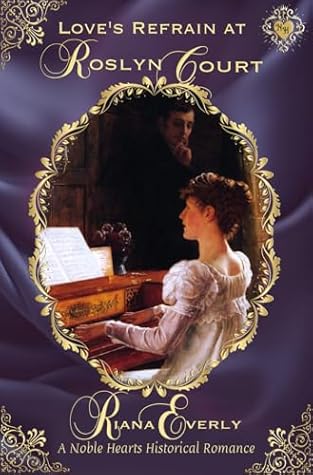
 I’m not usually a fan of the whole damaged-by-war scenario that afflicts so many Regency heroes these days, but this is a great example of the type, very well-written and with a gentle, slow-burn romance – the very best kind.
Here’s the premise: Sophia Bradley is the abandoned child of a scandal-riddled marriage, happy to be taken in by her uncle and aunt. Her kindly if distant uncle ensured she was raised to the same standard as her cousins, even paying for extra tuition to nurture her talent as a musician. Her aunt is content to see her as nothing but the poor relation, a useful dogsbody to be ordered about and subtly kept in her place. When the family’s younger son is killed in the war against Napoleon, the family is thrown into disarray by the arrival of Major Isaac Hollimore, bringing Henry’s effects with him. Overtaken by illness, he’s invited to stay as long as he wants. He’s happy to do that, especially when he discovers that Sophia’s music helps him forget the horrors of war that still haunt him.
Easy to see where this is going, but Isaac feels himself unfit even to consider marriage, and Sophia’s just the poor relation, isn’t she? And then when it’s revealed that Isaac is going to inherit a viscountcy in time, Sophia’s aunt plots to throw her daughter Louisa in his way, and keep Sophia away from him. And when a charming and handsome neighbour appears, and singles Sophia out for attention, the stage is set for some serious angsting.
This is very much a book based on the two protagonists’ idea that they’re deeply unworthy of being loved. Isaac feels he’s too damaged by his battlefield experiences, which leave him with desperate dreams and dark moods. Sophia feels that her scandalous family history will preclude any respectable man from marrying her, and sees her future as the permanent poor relation, acting as secretary, companion or governess to her relations, or even in a paid position. It takes them the whole book to shake off these feelings of unworthiness, and to be frank, I wanted to bang their heads together sometimes. Even at the end, they have to be chivvied into finding their own happiness by their friends.
I mentioned that I’m not a fan of the damaged hero trope, but despite that, and the amount of soul-searching that Isaac goes through, I still found this a compelling story. I loved that Sophia’s music is the medicine that helps Isaac to heal. I found that totally plausible. Authors sometimes underestimate the power of music to affect us in a very direct, subliminal way. For anyone who is musical, the author names all the pieces that Sophia plays, a nice touch.
The book is beautifully written, and although the author is Canadian, I only spotted one error in the whole book. When she talks about Isaac’s impending elevation to a viscountcy, she uses the expression ‘a seat in Lords’ (meaning the House of Lords in Parliament); Brits would say ‘in the Lords’ or ‘in the Upper House’ or ‘in the Upper Chamber’. It’s like High Street, always a ‘the’ in front (but not for London Road, Bath Road or whatever, unless you say ‘we’re on the Bath road’. But someone would live on London Road or THE High Street. Weird, I know. If not for that missing ‘the’, I’d have believed the author was British, so kudos for that.
A lovely book, unusual for its emphasis on music. A little too angsty for me, which keeps it to four stars, but I found it a compelling read all the same.