 I’ve read a couple of the author’s works under the pen name Melinda Hammond (Autumn Bride and Dream Chasers) and loved both of them. This didn’t resonate with me in quite the same way, but it’s still an absorbing, powerful read that I tore through in a day.
Here’s the premise: wealthy cit’s daughter Ellen Tatham and duke’s son Max Colnebrooke met, fell in love and married in a whirlwind romance in Egypt. But the fortunes of war meant that Max had to send his bride away to safety, and in the confused circumstances they both came to believe that the other has betrayed them. She ran away to Harrogate, pretending to be a widow to account for the birth of her son, James, while Max hurled himself into ever riskier enterprises, only returning when the unexpected death of his elder brother makes him the Duke of Rossenhall. Now he finds himself in Harrogate visiting old friends and meets up with Ellen again.
Now this is a delicious situation, because the two are thrown into any number of public meetings (what a lot of balls they had in Harrogate!), yet no one knows they are married, and there are reasons (of course there are!) why the secret can’t be revealed immediately. And there’s a big surprise for Max – he has a son and heir. So there’s a huge amount of tension between the two protagonists right from the start, both bitter about the apparent betrayal of the other, and yet still very much drawn to each other.
And this is, fundamentally, the whole plot. The two circle with stiff Regency politeness around each other, accepting that they have to live superficially as husband and wife because of their son, but trying very hard not to give way to the desire that lurks just below the surface. They don’t always manage it, so there’s the occasional passionate kiss and even a whole night of passion before they revert to that oh-so-restrained politeness. When they arrive at the ducal estate, there’s a malicious sister-in-law to contend with (widow of the older brother), and Ellen sets about making herself charming and duchess-like to servants, the steward, the tenants and the local residents.
And that is one of the problems with this book – Ellen is just a little too perfect. She’s beautiful, clever, a great manager, a wonderful mother and everyone loves her. I like a little more grit in the oyster, frankly. Max is pretty damn perfect, too, except for the whole guilt trip, which he places entirely on his wife’s shoulders. I suppose to be honest, the one problem they both have is pride – too much pride to confess what they really feel, or even to sit down and have a proper conversation. After all, there’s surely one subject they ought to be discussing openly, and that’s whether they intend to have more children. That’s what marriage is for, after all, if you’re a duke with a title and vast wealth to pass on. One heir really isn’t enough. But they never address the issue at all.
The story is a fairly simple one. There are no great mysteries or backstory revelations to unfurl, the minor characters are either out and out villains like the sister-in-law, or they’re saccharine sweet. Only Ellen’s old friend, the globe-trotting Miss Ackroyd, shows some spark of an interesting character (interesting to me, anyway; these things are deeply personal). And I have to say, I was a little unsettled to see the fresh widow jump immediately into a new romance. It seemed a little tasteless to me.
But none of these minor grumbles interfered very much with my enjoyment, and as I say, I romped through the book in no time, neglecting a lot of essential tasks to keep reading, which is always the sign of a good book. This one is deeply satisfying at the emotional level as the two main characters work through their bitterness to reach a rapport, although it took them perhaps a few chapters too many to get there. There’s some sex, but it’s tastefully done, and the writing is superb. Happily, not a single historical inaccuracy dinged my over-sensitive pedantometer. A good four stars.
 This book was an absolute delight. I love a book that takes me by surprise, and this book is surprising in spades. It features a downtrodden spinster, aged forty, a diffident vicar, aged more than forty, a motherly cook/housekeeper, and an impoverished but charming villain. Oh, and a dragon, but that part isn’t so much of a surprise, given the title.
 I almost gave up on this book at about the 20% mark. Neither of the main characters struck me as being particularly interesting, and the plot was so obvious it was probably visible from space. Basically, I was bored. But I decided to read a couple more pages, just to remind myself why I was abandoning it, and somehow I got sucked in. And then there were Issues at the end so it fell apart rather, but it had its moments in the middle.
 I’ve had this sitting on my Kindle for a while, but I was reluctant to start it, for some reason. My experiences with Joan Smith have been variable, to put it mildly, ranging from five stars to bailing out after a couple of chapters. This one seemed like it might fall into the oddball category, and so it does, but it’s also wildly funny, with some glorious exchanges between the two principals.
 Well, here’s a thing – a Sofi Laporte book that didn’t have me squealing with delight. I’ve enjoyed both the previous books, so what went wrong with this one? Nothing in the writing, that’s for sure. Again the author creates an original and entertaining story out of seemingly tired old tropes. But for me it veered too far off the track of a conventional Regency and into the realm of straight-up slapstick Gothic. Not my favourite thing. But if you’re in the market for Laporte’s unique take on beauty (sort of) and the beast, this may very well hit the spot.
 Another lovely read from Jenny Hambly, and for me this is the best of the series so far. Laurence is exactly my kind of hero – reserved, dignified and every inch the perfect gentleman. Heroine Cassandra is a feisty and determined lady, someone we can all root for. The plot unfolds smoothly, and is a joy to read.
 Surprisingly, this book opens with almost the same plot as the previous book in the series, with a young widow deciding to take a lover. The reasons are different, and the characters are very different, but it’s still an odd choice and felt awkward to me.
 Every Mary Balogh book is worth reading, but they do vary in likeability. The previous three books in this series I rated 5*, 3* and 4*. This one is back to 5* for me, mainly because I liked both the main characters, the romance was a pleasant slow burn, and there were no huge implausibilities in the plot. There was altogether too much angst, but that’s par for the course, and there was the bonus of the hero’s three sisters busily being older-sister-ish, plus several lovely minor characters.
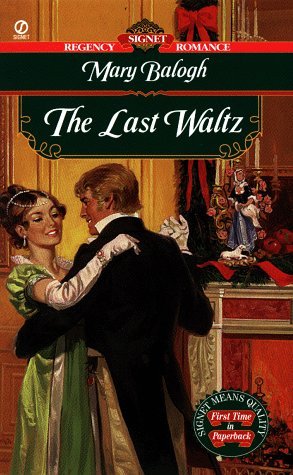 Mary Balogh has an unerring instinct for creating gloriously convoluted situations for her characters to face up to, and here she does it again. Ten years ago, Christina and Gerard were seemingly deep in love and on the brink of a betrothal when she abruptly agreed to marry his cousin, Gilbert, the Earl of Wanstead. Now Gilbert and his younger brother have both died, Christina produced only daughters, and Gerard has inherited the title and Thornwood, where he proposes to hold a house party over Christmas to choose a bride. His hostess? That will have to be Christina, the widowed Lady Wanstead.
 I’ve been meaning to read this for a while, because so many people whose opinions I respect love it and recommended it to me. Well, now I’ve read it and… meh. If you like lyrical descriptions of a rather idealised life on a remote Yorkshire farm, this is definitely the book for you. If, on the other hand, you’re looking for a compelling romance with credible obstacles to overcome and actual tension between the couple, best look elsewhere.