 Well. A difficult book to review because there’s so much wrong with it, as a multitude of scathing reviews attest, and yet it had its moments, and the author managed to hit her trademark emotional highs. I can forgive a great deal when a book makes me tear up.
Here’s the premise: Alexander Stewart, Viscount Merrick, heir to a dukedom, is on his way to London to finalise his betrothal to Lady Lorraine, daughter of a marquess. He’s caught in a snowstorm and seeks shelter at the nearest habitation, a large house containing only one female servant, Anne Parish. He orders the servant about, and considers quite seriously whether to bed her, but only backs away when he realises she is innocent and that might result in a great deal of tedious squawking. He really is an arrogant, entitled jerk at this point.
The next morning, he discovers his error. She’s not a servant but the unassuming sister of the owner, who returns mid-morning with the vicar, finds Alex in residence and sets up an even more tedious squawking. His sister has been compromised, he says, and he expects Alex to marry her pronto, and so does the vicar. And Alex tamely does so, even putting some effort into being charming to Anne, so that she’s quite convinced that he’s fallen in love with her. Not so, for as soon as the wedding is over, he takes her to Redlands, a much-neglected minor property of his, and dumps her there. But not before telling her in the harshest terms that he thinks she’s trapped him into marriage. Oh, and also not before bedding her, and discovering the passionate woman within. Lovely guy.
Let’s just unpack some of that. First of all, there’s really no need for him to marry her at all. He’s the heir to a dukedom, after all, and she’s lower gentry, at best. Besides, he’s already committed to the lovely Lorraine, not officially betrothed but with a clear understanding. Further, nothing actually happened between Alex and Anne, and no one knows about it except the brother and the vicar, and are they really likely to tell the world? Hardly. So by far the most sensible answer is for Alex to simply apologise for mistaking her for a servant, but refuse to marry her. After all, he would have died if she hadn’t taken him in, and that would be slightly unreasonable, merely to preserve her reputation.
Secondly, what is Alex thinking of to propose with politeness and even charm, and then turn on Anne so viciously? Where are his gentlemanly manners? She’s his wife, for heaven’s sake, and even though she isn’t the wife he wanted or expected, what’s done is done, and he could at least be courteous to her. But no, he refuses to let her leave Redlands for any reason, taking up with a mistress in London and to all intents and purposes ignoring Anne altogether.
She has a bit more gumption, so after a weepy phase, she picks herself up, and gives herself, the house and the garden a makeover. I always disapprove of the ugly-duckling-to-swan routine, so beloved of romance books, as if a plain, dumpy girl can’t be loved for herself, but here we go again. She loses weight, and allows her maid to turn her into an elegantly fashionable lady. And lo and behold, she’s beautiful! Who’d a thunk it?
An aside here about the weight thing. The Regency, in fact the whole of history up until perhaps the 1920s, was an age of conspicuous consumption. If you had money, you flaunted it. Queen Elizabeth I wore jewels stitched onto her gowns. The Georgians wore gorgeous brocades and wigs too elaborate to do any actual work in. The Regency saw women in impractical pale muslins, and men in equally impractical white, starched cravats, to prove they had enough clothes to change frequently. The Victorians put their women in vast hooped skirts using yards and yards of material. And all of them saw nothing wrong with eating heartily. You’ve only got to look at the portraits of the era to see the nicely rounded arms and shoulders of the women. Only poor people were thin. But even in Balogh’s later series, she’s still putting out the idea that plump women are less than ideal.
Needless to say, Alex can’t avoid Anne altogether and eventually his ducal grandparents force them together by inviting them both to a house party, where Alex naturally fails to recognise his now beautiful, fashionable wife. Again, he blows hot and cold, ignoring her during the day and bedding her enthusiastically at night. But the duchess has a cunning scheme to force a reconciliation, by making all the young ones perform in a play and… No, let’s not talk about the play. It was all too tedious for words, with a cast of thousands of cousins, about whom the reader doesn’t give a fig. And of course, Alex and Anne inch towards an accommodation and even (surely not?) love.
Naturally, it’s not as simple as that, because Alex is *still* an arrogant, entitled so-and-so. Unbelievable. Here’s the thing, arrogant, entitled hero – if you want to make your wife happy, you have to start by finding out what that might be, not just by assuming you know what she wants. She soon sets him straight on that one, giving him both barrels and then some, and finally, at long last, a tiny drop of humility seeps into his arrogant, entitled head. And it gets kind of emotional, which is a thing that Mary Balogh does exceptionally well. Almost that final moment got my rating up to four stars. Almost.
But he’s just such a horrible hero, I can’t quite forgive him, so three stars it is.
 A warning: this is going to be slightly spoilery, because it’s impossible to analyse the book properly without getting into the nitty-gritty, so if you really don’t want to know anything, don’t read on.
 Surprisingly, this book opens with almost the same plot as the previous book in the series, with a young widow deciding to take a lover. The reasons are different, and the characters are very different, but it’s still an odd choice and felt awkward to me.
 Every Mary Balogh book is worth reading, but they do vary in likeability. The previous three books in this series I rated 5*, 3* and 4*. This one is back to 5* for me, mainly because I liked both the main characters, the romance was a pleasant slow burn, and there were no huge implausibilities in the plot. There was altogether too much angst, but that’s par for the course, and there was the bonus of the hero’s three sisters busily being older-sister-ish, plus several lovely minor characters.
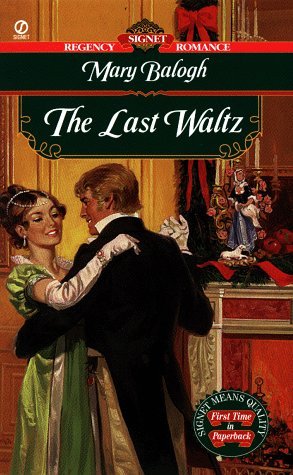 Mary Balogh has an unerring instinct for creating gloriously convoluted situations for her characters to face up to, and here she does it again. Ten years ago, Christina and Gerard were seemingly deep in love and on the brink of a betrothal when she abruptly agreed to marry his cousin, Gilbert, the Earl of Wanstead. Now Gilbert and his younger brother have both died, Christina produced only daughters, and Gerard has inherited the title and Thornwood, where he proposes to hold a house party over Christmas to choose a bride. His hostess? That will have to be Christina, the widowed Lady Wanstead.
 Here’s the premise: Lord Astor has recently come into his title and estates, and knows he has an obligation to marry to secure the succession. He also owes an obligation to the widow and daughters of his predecessor, who have been left unprovided for. He can fulfil both requirements at once by marrying one of the daughters. He’s never met them, for the relationship is a distant one, but he’s unbothered by which one it should be. After all, what does it matter? His wife won’t be a big part of his life, will she? Apart from producing a few children, she’ll have her own life and he’ll keep his mistress and his masculine friends and pursuits. So he leaves it up to their mother to decide which one is most appropriate. Since the eldest daughter and beauty of the family, Frances, is likely to marry a neighbour, she puts forward her second daughter, Arabella, to marry the viscount. And after a brief period of misunderstanding, and thinking he’s going to get the beauty, he swallows his disappointment and proposes to Arabella, the small, plump one.
 This was a difficult book for me to judge. Were it by an author unknown to me, I’d probably have gone with 2*, but with Balogh I’m prepared to see it as an aberration, a brave stab at something that ultimately failed. It ranks, however, as by far the most boring Balogh book I’ve ever read.
 I honestly don’t know what to make of this. It’s Mary Balogh, so it’s beautifully written, that goes without saying. In fact, I would describe it as compelling. Yet I had problems with it right from the off, and not just minor grumbles, but great big NO-NO-NO problems. So it was a weird read for me. I’m still conflicted.
 This is a book of two halves. The first half is a corker, crackling with tension on every page, and quite riveting. Then the protagonists get married and it devolves into a schmaltzy snoozefest, with our hero and heroine playing happy families, frolicking naked in the lake and having long, thoughtful discussions about whether they ought to fall in love or not. The ending is both highly predictable and kind of a con trick, frankly. And everyone sheds tears of joy and lives happily ever after.
 Once you’ve read a few Mary Balogh books, you begin to have some feel for what one is like, and this book… just isn’t it. She’s written edgy, challenging stuff, and she’s written angst-heavy emotional stuff, but this lightweight, witty and downright frivolous stuff? Not so much. But boy, did I enjoy it. This is the Balogh book for those who don’t like Balogh books.